
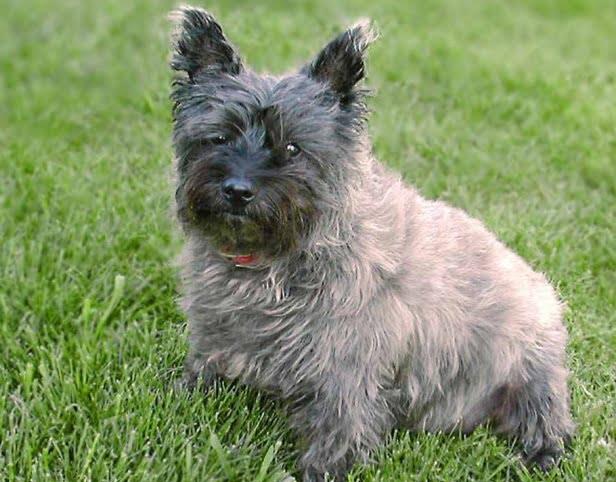
People usually look up Cairn Terriers when they’re weighing up a puppy, trying to understand a new rescue’s behaviour, or checking whether a “small terrier” lifestyle will really fit their home. The details matter: this is a compact dog with a working past, a bright mind, and a coat that asks for the right kind of maintenance.
Below is a clear, practical guide to what a Cairn Terrier is like to live with—size and temperament, exercise and training, grooming, and the health checks worth knowing before you commit.
Cairn Terrier at a glance
- Height: about 28–31 cm at the withers1
- Weight: ideally 6–7.5 kg1
- Coat: weather-resistant double coat; harsh outer coat with a soft undercoat1
- Colours: cream, wheaten, red, grey or nearly black; brindling accepted; not solid black, white, or black and tan1
- Typical lifespan: around 12–15 years2, 3
- Originally bred for: working terrier duties, including vermin control in rocky terrain (“cairns”)4
History and origin
The Cairn Terrier comes from Scotland, shaped by hard ground and practical work. In the Western Highlands and the Isle of Skye, these dogs were used to hunt and flush vermin sheltering among stone piles and rocky outcrops—exactly the sort of place a small, tough terrier can reach when larger dogs cannot.4
The name “Cairn” reflects that landscape: cairns are small piles or ridges of stones, common in the Highlands. Over time, Cairns and several other Scottish terriers remained closely related in ancestry, even as they separated into distinct breeds.4
Physical characteristics and appearance
A Cairn Terrier is small, sturdy, and built to move through scrub and rock without fuss. The silhouette is compact, with a weatherproof coat that’s meant to feel harsh rather than silky.1
That double coat is not just decoration. The outer layer helps shed dirt and moisture, while the undercoat provides insulation. When it’s maintained properly, the coat sits with a natural, tousled look that suits the breed’s working roots.1
Temperament and personality
Cairn Terriers tend to be alert, curious, and busy in the way many terriers are—quick to notice movement, ready to investigate a sound, and often inclined to dig or chase if the opportunity appears.5
They’re often affectionate with their people, but they are not usually a “put me in a handbag” kind of small dog. Many Cairns enjoy making their own decisions, especially outdoors, which is why calm, consistent training matters early.
What this can look like at home
- Watchfulness: quick to alert when something changes (visitors, wildlife, new noises).
- Terrier instincts: interest in chasing and digging is common, particularly without enough enrichment.5
- Independence: may test boundaries, especially if training is inconsistent.
Training and exercise needs
Most Cairn Terriers do best with daily exercise plus small pockets of mental work—short training sessions, sniffing games, and simple problem-solving. Many breed guides put their daily exercise needs at around an hour, adjusted for age and health.4
Training tends to go well when it’s reward-based. Harsh corrections can backfire in terriers, creating avoidance or escalating arousal rather than building steady habits. The RSPCA supports reward-based (positive reinforcement) training as an effective and humane approach, and does not support punishment-based methods.6
Simple training approach that suits most Cairns
- Keep sessions short (a few minutes), especially for puppies.
- Reward what you want to see again: calm check-ins, loose-lead walking, coming when called.
- Practise “leave it” and recall with low-value distractions first, then slowly increase difficulty.
- Plan for management, not just training: secure fencing and a lead in unfenced areas help when the chase instinct kicks in.
Grooming and coat care
The Cairn coat is meant to be harsh and weather-resistant, and grooming choices affect how it behaves. Regular brushing helps prevent tangles and helps lift out shed undercoat. For many Cairns, maintaining the traditional coat texture involves hand-stripping rather than clipping; clipping can soften the coat and change its protective qualities over time.7
Bathing is useful, but frequent bathing can make some coats harder to manage. Aim for “as needed”, and focus more on brushing, combing, and checking the skin and ears.
Everyday coat checklist
- Brush and comb weekly (more often in high-shed periods).7
- Check for knots behind ears, under the collar/harness, and in the “trousers”.
- Keep nails trimmed and paws checked after outdoor adventures.
Health concerns to know about
Cairn Terriers are often described as generally robust, but like all breeds they can be affected by inherited or age-related conditions. The most useful approach is not to assume problems, but to plan sensible screening and vet checks—especially for eyes and joints.
Eyes (including cataracts and progressive retinal atrophy)
Progressive retinal atrophy (PRA) is a group of inherited retinal diseases that cause gradual vision loss and can progress to blindness. It is typically non-painful, often first noticed as difficulty seeing in low light, and there is no cure—though many dogs adapt well to vision loss.8
Because different genetic variants can cause PRA, and not all forms have a known variant, a “clear” DNA test for one variant does not guarantee a dog won’t develop PRA. Talk with your vet or breeder about eye screening and what’s known for the lines involved.8
Joints (including hip dysplasia)
Hip dysplasia is most common in large breeds, but it can occur in small dogs too. It involves abnormal development of the hip joint, which can lead to joint laxity and osteoarthritis over time. Signs vary—some dogs show stiffness or lameness after exercise, while others show little outward change.9
If you’re buying a puppy, ask what screening the parents have had. If you’re adopting an adult, ask your vet whether any gait changes or discomfort warrant further investigation.
Breed standards and kennel club recognition
In Australia, the Cairn Terrier breed standard (including ideal height, weight, coat, and acceptable colours) is set out by Dogs Australia (formerly the Australian National Kennel Council / ANKC). It’s written for conformation, but it’s also a handy reality check when you’re comparing breeders or assessing whether a dog is likely to be a Cairn type.1
Internationally, Cairn Terriers are also recognised by major kennel clubs such as The Kennel Club (UK) and the American Kennel Club.3, 4
Final thoughts
A Cairn Terrier is small, but rarely “low effort”. When their exercise, training, and coat care are handled with quiet consistency, they tend to be lively, companionable dogs with real presence—still shaped by a history of purposeful work in rough country.
References
- Dogs Australia (ANKC) – Cairn Terrier breed standard
- Cairn Terrier Club of America – General information (size and lifespan)
- American Kennel Club – Cairn Terrier breed information
- The Kennel Club (UK) – Cairn Terrier (history and exercise guidance)
- Cairn Terrier Club of America – General characteristics (behaviour tendencies)
- RSPCA Australia – Reward-based training and positive reinforcement
- Dogs NSW – Cairn Terrier overview (coat maintenance and hand stripping)
- Cornell University College of Veterinary Medicine – Progressive retinal atrophy (PRA)
- Merck Veterinary Manual (Pet Owner Version) – Hip dysplasia in dogs

Veterinary Advisor, Veterinarian London Area, United Kingdom