
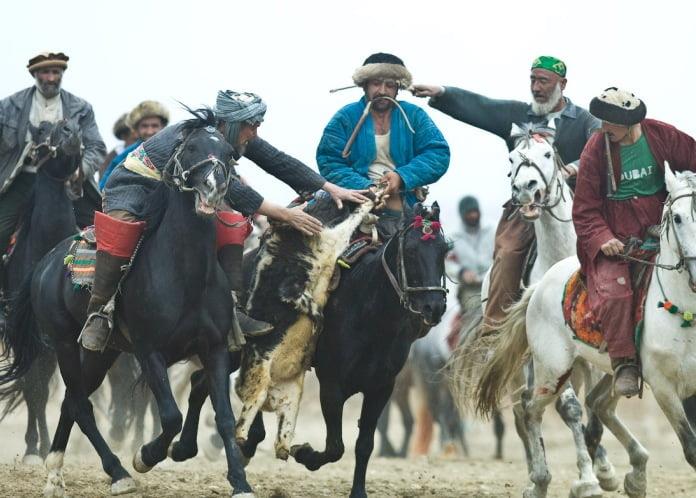
Most people look up buzkashi to answer a practical question: what, exactly, is that dust-choked Afghan horse game where riders wrestle for a carcass—and is it really played the way the footage suggests? The details matter. Without them, it’s easy to confuse buzkashi with polo, to misread the roughness as lawlessness, or to miss why it still draws crowds in the midwinter cold.
Buzkashi is a traditional Central Asian equestrian sport, best known in Afghanistan, where skilled riders (often specialists) fight for control of a goat or calf carcass—or, increasingly at organised events, a weighted synthetic substitute—then race to a scoring area while others try to stop them.1, 2 What follows is the clearest way to understand it: where it comes from, how matches are commonly run, what equipment is actually used, and why it sits so deeply inside Afghan public life.
What is buzkashi?
Buzkashi (from Persian for “goat dragging”) is played on horseback. Competitors seize a decapitated and dehoofed goat or calf carcass (historically the carcass itself; in some modern tournaments, a purpose-made substitute), hold it tight against the leg or saddle, and ride through pressure to reach a goal or designated scoring zone.1, 2
It is often described as rugged, even violent, because the contest happens at close quarters: horses shoulder in; riders lean low, one boot searching for ground while the other locks into the stirrup, and the carcass becomes a heavy, awkward weight that must be carried without letting rivals peel it free.2
Where it’s played (and where it’s not)
Buzkashi is most strongly associated with Afghanistan—particularly the north—though related versions are played across Central Asia under other names (such as kokboru/kokpar/ulak tartysh) and in parts of north-western China.1, 2
Claims that buzkashi has “become popular in Australia” are overstated. You may find diaspora community events, exhibitions, or media coverage, but it isn’t an established mainstream Australian sport in the way polo, campdrafting, or rodeo are.
Origins and evolution: from nomadic horsemanship to public spectacle
Most scholarly summaries trace buzkashi to the nomadic Turkic peoples who moved west from China and Mongolia between roughly the 10th and 15th centuries, with the game likely growing out of practical horse skills linked to herding and raiding.2
In the 1950s, Afghanistan’s central government began hosting national tournaments in Kabul, bringing a more controlled, “official” format alongside the older, looser village and provincial styles.1, 2 The two modes still sit side by side: one bounded and refereed, the other sprawling and negotiated in motion.
How a match works: two main styles you’ll hear about
Rules vary by region and event, but many descriptions group buzkashi into two broad forms:1, 2
Traditional tūdabarāy (free-for-all)
In tūdabarāy, there may be no formal teams and no crisp field boundaries. Riders surge from a packed scrum to gain sole possession, then try to get “free and clear” with the carcass—an idea that sounds simple until you watch a dozen horses clamp down around a single line of travel.1, 2
Modern qarajāy (team-and-goals format)
In qarajāy, teams play on a defined field with set scoring areas. This format is easier to referee and easier to stage as a spectator event, especially in large tournaments.1, 2
What counts as “winning”?
Winning depends on the local ruleset, but the core aim is consistent: secure the carcass, keep it under control through contact and pursuit, then complete the scoring requirement (reaching a goal area or dropping/placing the carcass in a designated spot).1, 2
Matches can be short rounds or long contests across a day, with prizes awarded per round or per final result—sometimes money, sometimes animals, sometimes prestige items, and always status for riders and sponsors.2
Equipment and animals: what’s accurate (and what isn’t)
The “ball” is not a ball
The playing object is traditionally a decapitated, dehoofed goat or calf carcass. It is not “cut into pieces and sewn together”, and it is not “filled with coins”. Those details are inaccurate and should be removed.1, 2
In some modern tournaments, organisers use a synthetic substitute designed to mimic the weight and handling of a carcass, partly for practicality and standardisation.3
Horses
Horses are the true engine of the sport: powerful, compact animals trained to push into crowds, pivot sharply, and hold a line while their rider leans dangerously low to lift the carcass from the ground.2
Whips and protective gear
Riders may carry whips, mainly as aids for controlling their own mounts and managing space in a tight pack, though practices vary by place and event. Clothing is often heavy, with protective headgear common in organised play, reflecting the very real risk of falls, kicks, and collisions.2
Culture and meaning in Afghanistan
Buzkashi isn’t only a sport. In many areas it is a public gathering where sponsorship, local influence, and reputation are tested in front of a crowd—horses bred and trained by patrons, specialist riders hired to compete, prizes displayed as proof that the host can afford to reward the winners and keep order.2
Even where it’s framed as “lighthearted fun”, it often sits inside a wider social landscape: who funds the event, who controls the field, and who is allowed to attend. Recent reporting on major tournaments has noted large crowds and official attendance in Kabul, alongside restrictions that bar women from the stands under current rules.4
Famous players: handle names with care
Lists of “famous buzkashi players” online are often poorly sourced, and many names circulate without clear verification. Rather than repeating uncertain profiles, it’s more accurate to describe the recognised role within the sport: elite riders are called chapandāz (plural chapandāzān), specialists whose experience and tactical strength can dominate a match.2
If you want to include notable individuals, use names that can be confirmed through reputable reporting or scholarly sources, and cite them directly.
Tournaments: where it’s watched today
Large tournaments are still held in Afghanistan and draw substantial crowds. Recent coverage of Kabul’s annual tournament describes multi-day competition, organised teams, and—at least in some events—a synthetic “carcass” used for play.3, 4
Avoid pointing readers to vague “Buzkashi TV” or unverifiable streaming sites. Coverage from established newsrooms and documentary outlets is a safer guide for viewers outside the region.
Preservation and change: what’s actually under threat
It’s tempting to say buzkashi is “disappearing”, but the picture is uneven. In some places it remains vibrant; in others, the pressures are practical (cost of horses and care, access to safe playing fields, security and travel restrictions) or political (what public gatherings are permitted, and who can attend).4
Separately, UNESCO’s work in Afghanistan focuses on safeguarding cultural heritage broadly—sites, museums, and cultural practice—especially during periods of instability, because losses to heritage can be permanent and hard to reverse.5
Buzkashi in film and literature
Buzkashi appears regularly in documentary photography and reportage, and it turns up in fiction as a shorthand for Afghanistan’s speed, grit, and public theatre. A well-known example is Joseph Kessel’s novel Les Cavaliers (“The Horsemen”) and its film adaptation, which helped introduce the sport to wider audiences outside the region.2
Some popular-culture claims need correction. For example, the Afghan film Osama (2003) is not about a girl disguising herself to play buzkashi; its story concerns a girl disguising herself as a boy to work and survive under Taliban rule, and it does not centre on buzkashi.
Final thoughts
Buzkashi endures because it matches the landscape that produced it: big horses, open ground, winter crowds, and a kind of skill that’s half balance, half nerve, half animal handling—always shaped by local custom and the people who sponsor and control the day.2
If you’re watching for the first time, keep two ideas in view. The rules can be looser than you expect, or stricter than you assume, depending on the event. And beneath the dust and noise, the sport is also a social stage—one where status, resources, and tradition are tested in public.
References
- Encyclopaedia Britannica — “buzkashi” (summary)
- Encyclopaedia Britannica — “buzkashī” (G. Whitney Azoy)
- Associated Press — Photos capture Afghanistan’s traditional buzkashi tournament near Kabul (Dec 2025)
- Associated Press — Thousands turn out in Kabul to cheer on Afghanistan’s traditional buzkashi equestrian games (Dec 2025)
- UNESCO — Afghanistan: UNESCO calls for the protection of cultural heritage in its diversity (updated Apr 2023)

Veterinary Advisor, Veterinarian London Area, United Kingdom