
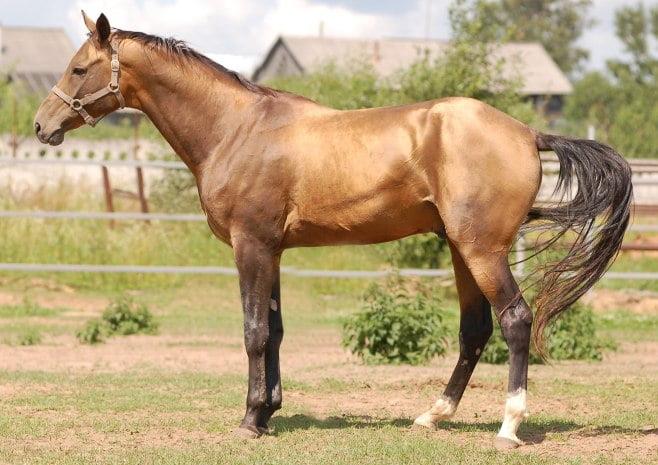
People usually look up the Budyonny (also spelled Budenny or Budyonny) when they’re trying to check the basics fast: what it is, how big it gets, what it’s like to ride, and whether it suits sport, endurance, or everyday work.
The details matter because this is a purpose-bred cavalry horse turned modern sport horse. Get the origin story or the key traits wrong and you end up with the wrong expectations about size, soundness, and the kind of management it thrives under.
Budyonny horse at a glance
- Origin: Southern Russia (former Soviet Union)1, 2
- Height: commonly about 15.1–16.3 hands (roughly 155–165 cm)2, 3
- Weight: often around 500–600 kg (varies with type and condition)6
- Typical coat colours: usually chestnut (often with a golden sheen); bay is seen; grey and black are reported but less common2, 3
- Temperament (general): commonly described as good-tempered, trainable, energetic and willing (individuals vary)3
- Common uses: all-round riding and competition (showjumping, eventing, dressage), plus driving/light carriage work2, 3
- Distinctive look: strong, athletic build with sloping shoulders, pronounced withers, long neck and robust hooves3
- Breed-specific health issues: no single “signature” disease, but conformation faults are reported in some lines (e.g., offset cannons, straighter hind limbs)2, 3
History and origins
The Budyonny was developed in the Soviet period as a modern cavalry mount—fast, tough, and able to hold condition in the steppe. The key cross was Don mares with Thoroughbred stallions, followed by breeding within the new population until a stable type was established.1, 3
The breed is named for Marshal Semyon Budyonny (Budennyi), who was closely associated with the cavalry and with the stud farms involved. The Budyonny was officially recognised as a distinct breed in 1949.1, 2
Physical characteristics
Seen side-on, a typical Budyonny reads as a long-lined, athletic horse: a straight-profiled head, a long neck, sloping shoulders, a deep chest, a strong topline, and sturdy legs set up for covering ground efficiently.2, 3
Most are chestnut, often with the warm, metallic sheen inherited through Don ancestry. Other colours occur, but chestnut dominates in most descriptions of the breed.2, 3
Temperament and rideability
Budyonny horses are widely described as trainable and willing, with enough energy for sport without being naturally “hot” in the way some full Thoroughbreds can be. As with any breed, handling and early education make a bigger difference than labels—especially for a horse built for work.3
Uses and roles today
While the Budyonny began as a military riding horse, it’s now most often discussed as a versatile competition and pleasure mount. It’s commonly seen in jumping-focused disciplines (including eventing) and also appears in dressage, endurance and driving work.2, 3
Care: feeding, hoof care, and day-to-day management
A Budyonny’s daily needs aren’t exotic. Think of it as an athletic riding horse with a reputation for hardiness: plenty of forage, steady conditioning, and routine health care.
- Diet: base the ration on quality pasture and/or hay, then adjust with concentrates only if workload and body condition justify it.
- Hooves and legs: keep farriery consistent; the breed is noted for good hooves, but any sport horse can be undone by neglected feet.2, 3
- Fitness: build work gradually. A horse bred for stamina still needs progressive conditioning to stay sound.
- Routine veterinary care: schedule vaccinations, dental checks, and parasite control appropriate to your region and paddock management.
Training notes
Budyonny horses were historically selected under structured testing systems. In practical terms, they tend to respond well to calm repetition, clear aids, and enough variety to keep the body supple and the mind settled.1
Health and soundness: what to watch for
There’s no widely recognised breed-specific disease that defines the Budyonny. The more realistic risks are the ordinary ones that follow any athletic career: wear-and-tear, management-related issues, and the occasional conformation weakness. Some sources note faults such as offset cannon bones or straighter hind limbs in part of the population, which is worth checking during a pre-purchase exam.2, 3
Challenges facing the breed
Outside its home region, the Budyonny is uncommon, and scarcity can make breeding decisions and genetic diversity more complicated. If you’re considering importing or breeding, it’s worth tracking official studbook information and current population reporting rather than relying on anecdotes.8
Final thoughts
The Budyonny is best understood as a practical animal shaped by a specific landscape and a specific job: an efficient, resilient riding horse that later stepped neatly into sport. When it’s well made and well managed, it tends to look and move like it belongs there—steady, ground-covering, and built to keep going.
References
- FAO — Animal Genetic Resources of the USSR: Budyonny (Budennovskaya)
- Wikipedia — Budyonny horse
- Oklahoma State University — Budyonny Horses
- Horses of the World — Budyonny horse (breed history overview)
- Wikipedia — Chernomor horse
- HorseBreedsPictures.com — Budyonny Horse: size and characteristics (summary page)
- Wikipedia — Tersk horse (context on Budyonny-era stud development)
- FAO — DAD-IS (Domestic Animal Diversity Information System)

Veterinary Advisor, Veterinarian London Area, United Kingdom