
People usually end up reading about Bronze-winged Pionus parrots when they’re weighing up a new companion bird: how big they really get, how loud they are in a typical home, what they eat, and whether they’re likely to cope with family life. With any parrot, the difference between “manageable” and “hard work” tends to come down to daily routine—diet, space, enrichment, and the quiet, repetitive work of building trust.
The Bronze-winged Pionus (Pionus chalcopterus) is a stocky, mid-sized pionus from the north-western Andes. In captivity they’re often described as steadier and less piercing than many parrots, but they still need a thoughtfully set-up home, a balanced diet (not a seed bowl), and an owner who can read subtle signs of stress before they turn into chronic problems.3, 5
Quick profile
- Scientific name: Pionus chalcopterus3
- Adult size: about 29 cm; roughly 210–240 g3, 4
- Talking ability: usually limited; some individuals learn a few words, but the species isn’t known as a strong talker6
- Noise level: often quieter than many parrots day-to-day, but can be harsh and screechy in flight or when excited4
- Longevity: commonly cited around 35–40 years with good care4
- Conservation status: IUCN Red List: Least Concern5
Physical characteristics
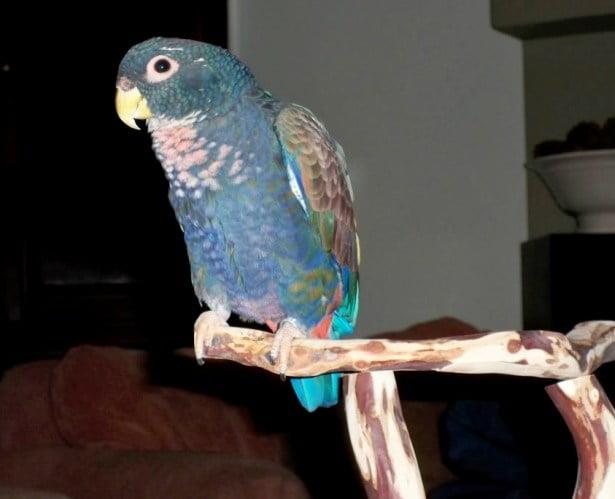
Bronze-winged Pionus parrots have the classic pionus build: compact, broad-headed, and short-tailed. In good light, the plumage reads as deep blue-purple with a bronze-brown head and neck, a pale chin, and the red undertail coverts that flash when they shift on a perch. The wings show the “bronze” that gives the bird its common name—a metallic, bronzy wash over the coverts rather than a single bright patch.3, 4
Adults are typically around 29 cm long. Weight varies by individual and condition, but references commonly place them in the low-to-mid 200-gram range.3, 4
Habitat and distribution in the wild
In the wild, Bronze-winged Pionus occur along the north-western Andes—from north-west Venezuela through Colombia, into western Ecuador and north-west Peru. They’re most associated with humid upland and montane forest, but can also be seen along forest edges and in partially cleared landscapes where tall trees remain.4, 5
Diet and feeding in captivity
Wild Bronze-winged Pionus forage high in the canopy and take a mix of fruit and other plant material. In captivity, the goal is a diet that supports long-term health, steady weight, and good feather condition—without turning the food bowl into a high-fat seed buffet.4, 8
Australian animal welfare guidance generally recommends that most pet parrots eat primarily a formulated diet (pellets), supported by vegetables, with seed and fruit used sparingly.1, 2
A practical daily diet pattern
- Base: a high-quality formulated pellet as the main food source2
- Fresh foods: a mix of vegetables (especially darker, more nutrient-dense options like leafy greens, broccoli, capsicum, carrot, legumes/peas/beans)1, 2
- Treats only: fruit and seeds (including sunflower) used in small amounts, often as training rewards rather than “free feed”1, 9
Foods to avoid
Some common kitchen foods are dangerous for parrots. RSPCA guidance includes avoiding avocado and limiting high-fat seeds; many veterinarians and welfare guides also warn against items like chocolate and caffeine products.2, 9
Social behaviour, temperament, and noise
Outside the breeding season, wild Bronze-winged Pionus can be social, seen in pairs or small groups, and they may gather at favoured feeding or roost sites. They nest in tree hollows.4, 5
In homes, they’re often described as calmer than many parrots, but calm doesn’t mean low-maintenance. They still need daily interaction, predictable handling, and things to chew and shred. Vocalisations can be surprisingly sharp—especially during flight, excitement, or seasonal hormonal periods—so “quiet for a parrot” is the most honest label.4, 6
Talking and mimicry
Some individuals learn a few words or sounds, but Bronze-winged Pionus are generally not regarded as strong talkers. If clear speech is the main goal, this species can be a poor match, even when well socialised and trained.6
Housing and enrichment
Think in terms of space, not just a cage. Bronze-winged Pionus do best with room to move, climb, and flap, plus daily time outside the enclosure in a bird-safe area. They’re also persistent chewers, so safe wood, branches, and destructible toys aren’t optional extras—they’re part of behavioural hygiene.4
- Perches: mixed diameters and textures to support feet and reduce pressure points
- Chew materials: untreated bird-safe branches/wood and replaceable chew toys4
- Foraging: puzzle feeders and scattered food portions to slow down eating and occupy the day
Breeding notes (overview)
In the wild, Bronze-winged Pionus nest in cavities and commonly lay clutches of around 3–4 eggs. In aviculture, successful breeding tends to depend on stable pairs, appropriate nest boxes, and a calm environment—plus careful management to avoid nutritional deficiencies and stress-related issues.4
Health and routine care
Most long-term health problems in companion parrots trace back to diet, weight, and chronic stress. A simple home routine helps you notice change early: weigh your bird regularly, watch droppings, and keep an eye on appetite and activity. Sudden weight loss, persistently “empty” droppings, or a bird that sits fluffed and quiet warrants prompt veterinary advice (ideally from an avian vet).1
A seed-heavy diet is a common pitfall; Australian welfare and veterinary sources repeatedly warn that all-seed feeding is unbalanced and can contribute to obesity and other nutrition-related disease.2
Conservation status and main threats
The Bronze-winged Parrot is listed as Least Concern on the IUCN Red List, meaning it is not currently considered globally threatened. Even so, parts of its range face heavy habitat loss, and local declines can still occur when forest is cleared or fragmented.5
Final thoughts
A Bronze-winged Pionus suits people who want a medium-sized companion parrot with a steadier presence and less relentless volume than many species—while still accepting the reality of parrot noise, mess, and long commitment. Get the food right, offer daily chewing and foraging, and build handling slowly and consistently. The bird you end up living with is often shaped less by species labels and more by the calm habits you practise every day.2, 4
References
- Animal Welfare League Queensland (AWLQ) — Birds (care, diet, monitoring)
- RSPCA Australia Knowledgebase — What should I feed my birds?
- PionusParrot.com — Technical descriptions (Bronze-winged Pionus profile)
- World Parrot Trust — Bronze-winged Parrot (Pionus chalcopterus)
- IUCN Red List — Search results for Pionus chalcopterus
- Susan Clubb — Bronze-winged Pionus (species profile)
- U.S. Fish & Wildlife Service — Bronze-winged Parrot (Pionus chalcopterus)
- PetPlace — Choosing a Bronze-winged Pionus
- RSPCA NSW — Bird nutrition

Veterinary Advisor, Veterinarian London Area, United Kingdom