
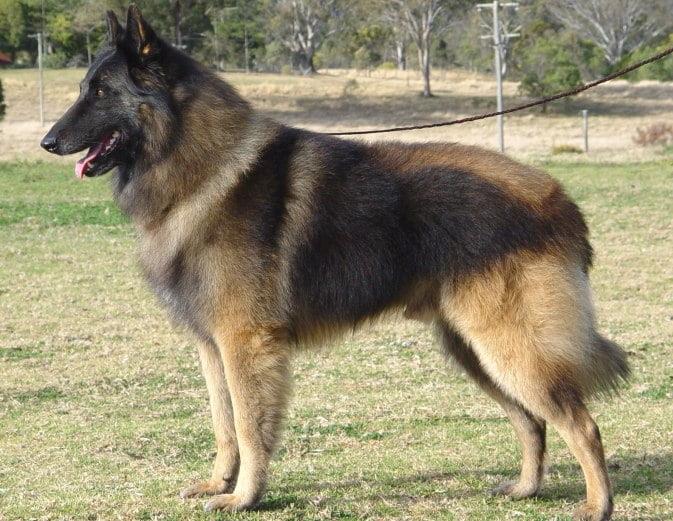
People usually end up looking up Belgian Shepherds when they’re weighing up a high-drive dog for the household: a companion that can keep pace on long walks, training sessions, and busy weekends. Get it right and you have a steady, watchful animal that thrives on work; get it wrong and the same energy can spill into nuisance behaviours, reactivity, or constant restlessness.
Below is a clearer, more accurate guide to what the Belgian Shepherd Dog is (and isn’t), how the four varieties differ, what daily life tends to look like with one in Australia, and the health and care points worth checking before you commit.1, 2
Breed family: Belgian Shepherd Dog (four varieties: Groenendael, Tervueren, Malinois, Laekenois)
Country of origin: Belgium
Size: Medium to large (adult height commonly around 56–66 cm, depending on sex and standard; weight varies by build and variety)1, 3
Also known as: In some countries, the “Belgian Sheepdog” name is used for the Groenendael (the long-haired black variety), while “Belgian Shepherd” may be used as an umbrella term for the four varieties.4, 5
Lifespan: Often around 12–14 years (varies by individual, care, and lines)
Care requirements: High (training, enrichment, grooming needs depend on variety)
Exercise requirements: High (daily physical work plus mental work)
What “Belgian Shepherd” means (and why the name can be confusing)
The Belgian Shepherd Dog is one breed with four recognised varieties, separated mainly by coat type and colour: Groenendael, Tervueren, Malinois, and Laekenois.2 In Australia, Dogs Australia (through state bodies such as Dogs NSW) presents the Belgian Shepherd Dog standard under those four variety names.1
In everyday conversation, people sometimes use “Belgian Shepherd” to mean the Malinois, because it’s the variety most often seen in protection sports and working roles. That shortcut causes mismatches: someone expects a tidy, short-coated “Malinois type” dog and ends up with a long-coated Groenendael, or a temperament from lines bred for a different kind of work.
History and origins
The breed took shape in Belgium in the late 19th century, developed as a capable herding and farm guardian dog, built to move for hours and stay alert in all weather. Early breed organisation and standard-setting in Belgium is commonly linked with veterinary professor Adolphe Reul, who described and helped formalise the type that later divided into the four coat varieties.6
Internationally, the Fédération Cynologique Internationale (FCI) recognises the Belgian Shepherd Dog and lists the four varieties under the same breed entry.2
Physical characteristics (by variety)
All four varieties share the same underlying build: an athletic, square-proportioned dog with quick feet and an elastic, efficient stride. What changes most is the coat—its length, texture, and permitted colours—and that changes the grooming load in very practical ways.1
Groenendael
Long-haired, solid black. The coat forms a heavier ruff and feathering, and it sheds seasonally in noticeable waves.1
Tervueren
Long-haired, typically fawn to grey with black overlay and a dark mask (as described in breed standards). It has the same long-coat management needs as the Groenendael, with more variation in colour and shading accepted by standard.1
Malinois
Short-haired, typically fawn with black overlay and a dark mask. It dries faster after rain and generally carries less coat into the house, though it still sheds and needs regular brushing.1
Laekenois
Rough-haired (wire), usually fawn with traces of black overlay. The coat texture is distinctive—dry, tousled, and more “rustic” in outline than the other varieties.1
Temperament: bright, watchful, easily bored
Belgian Shepherd Dogs are built for attention and action. In a settled adult, that often looks like a dog that tracks movement in the environment, learns patterns quickly, and stays close enough to keep you in sight. Many are naturally reserved with strangers; some will be more openly social, depending on genetics and early experiences.
They are not a “set and forget” breed. Without daily structure, they can rehearse their own entertainment—spinning, fence running, barking at passers-by, or fixating on moving objects. This isn’t spite or “dominance”. It’s an animal shaped for sustained work, left with nothing clear to do.
Training and exercise: what they actually need day to day
For most Belgian Shepherds, sheer kilometres aren’t enough. They need a mix of physical exertion and calm, repetitive thinking work—training that rewards steadiness, not constant arousal.
A practical daily baseline
- Physical exercise: brisk walking, running alongside (where safe), structured play, or sport training suited to the dog’s body and maturity.
- Mental work: short training blocks (obedience foundations, scent games, calm place work), food puzzles, and reinforcement of quiet behaviour in the home.
- Socialisation done properly: not forced greetings—just controlled exposure to people, places, surfaces, and sounds, paired with calm rewards.
Training style that tends to work best
Clear, consistent handling and reward-based training are a good fit for this breed’s speed of learning. The goal is not to “amp them up” but to build reliability: recall, leash skills, impulse control, and the ability to switch off. When the dog is young, protect joints and growth plates—avoid repetitive high-impact jumping until your vet or a sports-minded professional is comfortable with the dog’s maturity.
Health: what to watch for and what to screen
No breed is free of inherited risk. For Belgian Shepherds, owners and breed clubs commonly focus on orthopaedic and eye screening, with additional tests depending on lines and emerging evidence. In practice, that means you should expect reputable breeders to discuss (and ideally document) screening such as hip and elbow assessment and eye examinations, and to explain what’s common in their lines and why their breeding choices were made.7
Hip dysplasia is a well-known concern across many medium–large active breeds, and it’s specifically highlighted in general veterinary resources as an inherited/developmental condition that can affect mobility and comfort over time.8
Smart questions to ask a breeder or rescue
- What health screening has been done on the parents (hips, elbows, eyes), and can you show the results?
- What temperaments do you see most in your lines: social, reserved, sharp, sensitive, environmentally confident?
- How are puppies raised in the first eight weeks (noise exposure, surfaces, visitors, early handling)?
- What support do you provide if the match isn’t right?
Grooming and maintenance (without overcomplicating it)
All varieties have a dense coat with an undercoat; the long-haired varieties simply carry more of it. Dogs NSW describes the coat structure and how it differs between the four varieties in the breed standard, and those differences show up in the laundry basket at home.1
Basic routine
- Brushing: weekly for Malinois; often more for long-haired varieties; more again during seasonal sheds.
- Bathing: as needed. Overbathing can strip oils and worsen skin issues in some dogs.
- Nails, ears, teeth: short, regular sessions are easier than occasional battles.
Working roles: why they show up in police, defence, and sport
Belgian Shepherd Dogs are still used globally for herding, protection, detection, and search work, with the Malinois particularly common in high-intensity working roles. The underlying ingredients are consistent across varieties: athleticism, quick learning, and a strong response to training and reinforcement.
That doesn’t mean every Belgian Shepherd needs a uniformed job. It does mean most of them benefit from having a “job-shaped” life—clear routines, practice, and purposeful outlets.
Is a Belgian Shepherd a good fit for an Australian household?
They tend to suit people who enjoy daily training and don’t mind planning their week around a dog’s needs. They can be wonderful in active homes, but they rarely thrive as a backyard accessory.
Often a good match if you want
- a dog that learns fast and enjoys training
- a companion for regular exercise and structured dog sport
- a watchful dog with natural reserve around strangers (handled thoughtfully)
Think carefully if you need
- a low-maintenance breed that’s content with short walks
- a dog that happily greets every stranger without training and management
- a pet that can be left unstimulated for long stretches
Food and nutrition: keep it simple, keep it evidence-based
A Belgian Shepherd’s diet needs to match their body condition and workload, not just their breed label. If you’re unsure, start with a veterinary check and an honest body condition assessment, then adjust portions gradually.
The World Small Animal Veterinary Association (WSAVA) Global Nutrition Guidelines are widely used by vets as a framework for nutritional assessment and for cutting through food-label marketing, especially when weight or performance is drifting off course.9
Final thoughts
A Belgian Shepherd is a moving, listening dog—wired to notice, to learn, and to keep going. In the right hands, that becomes a calm, capable companion with a long memory for training and a deep readiness to work. The secret is not intensity. It’s consistency: good breeding, early socialisation, steady training, and a life that gives the dog something real to do.
References
- Dogs NSW (Dogs Australia) – Belgian Shepherd Dog (Groenendael, Tervueren, Laekenois, Malinois) breed standard
- Fédération Cynologique Internationale (FCI) – Belgian Shepherd Dog (Chien de Berger Belge) breed entry and varieties
- The Kennel Club (UK) – Belgian Shepherd Dog (Groenendael) breed standard (size guidance and general points)
- American Kennel Club (AKC) – Belgian Sheepdog (Groenendael) breed information
- American Kennel Club (AKC) – Belgian Malinois breed information
- American Belgian Malinois Club – History of the Belgian Malinois (includes early breed development and Adolphe Reul)
- Belgian Shepherd Dog Club of Queensland – Health position statement and recommended screening
- Cornell University College of Veterinary Medicine – Canine hip dysplasia overview
- World Small Animal Veterinary Association (WSAVA) – Global Nutrition Guidelines

Veterinary Advisor, Veterinarian London Area, United Kingdom