
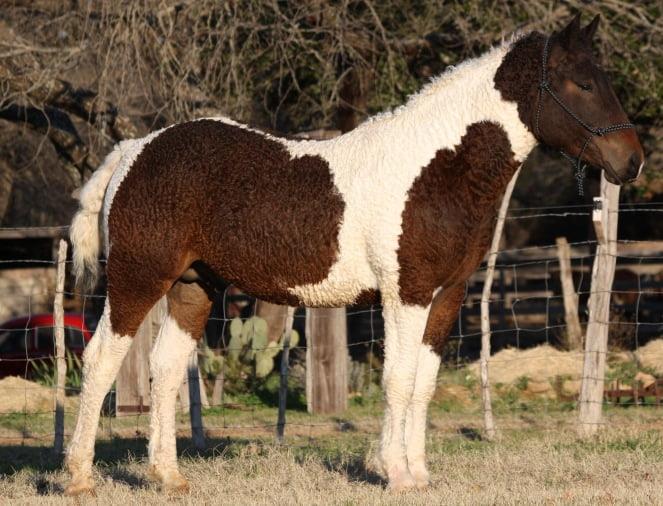
People usually start searching for the Bashkir horse when they’ve seen a compact, thick-coated horse labelled “Bashkir” and want to know what it really is: a distinct breed from Russia, a type of curly-coated horse, or something else entirely. Getting that identification right matters if you’re looking at temperament, size, hardiness, or even just whether the description you’ve been given is trustworthy.
The Bashkir is a hardy landrace breed from Bashkortostan (Russia), shaped by open-range herd management and bitter winters. It’s also often confused with the American Bashkir Curly, which is a separate North American breed with a curly coat and no proven link to the Bashkir horse.1, 2
Quick profile: Bashkir horse
- Typical height: about 142–143 cm at the withers (roughly 14.0–14.1 hands).3
- Build: small, wide-bodied, deep-chested; short, strong legs with substantial bone.3
- Coat and hair: thick winter coat (often described as curly in some individuals), with a heavy mane and tail.3
- Common colours: bay, chestnut, roan, mouse grey; striped dun can occur.1, 3
- Traditional uses: riding and farm work, plus milk and meat production; mare’s milk is commonly made into kumis.1, 3
History and origin
The Bashkir (also spelled Bashkurt) is the horse of the Bashkir people, raised mainly in Bashkortostan, a republic within the Russian Federation west of the southern Ural Mountains.1 Its deeper origins aren’t clearly documented, but by the 19th century its economic value was well recognised and organised breeding centres were established (including in the mid-1800s) to strengthen working ability while maintaining its traditional role as a producer of milk and meat.1, 3
Like many regional working breeds, the Bashkir has been influenced by crossbreeding at different times (including with the Russian Heavy Draught, and experimental crosses with other steppe-adapted horses).1, 3
Physical characteristics
The Bashkir is typically a small horse with a broad, sturdy frame: a large head, short neck, low withers and a deep chest, carried on short legs with heavy bone.3, 4 This build is practical rather than decorative—useful for pulling, packing, and keeping steady footing in mixed terrain.
Hair is one of the breed’s quiet signatures. The mane and tail are thick, and the winter coat grows dense and insulating; some sources describe it as “often curly”.1 Traditionally, hair combed from the winter coat has even been used for weaving.1
Temperament and way of going
Individual horses vary, but the Bashkir is generally described as a practical, durable working horse—steady enough for day-to-day handling and tough enough to keep going when conditions are unpleasant. The breed is noted for work endurance, including accounts of long-distance pulling in winter transport.1, 3
Hardiness and climate adaptation
Bashkir horses are managed in extensive herds and are noted for coping outdoors through severe winter weather, including snow and blizzards.1 That hardiness is paired with a coat that thickens markedly in cold seasons, a body that carries condition efficiently, and hooves and bone built for constant travel.
Uses: from farm work to fermented milk
The Bashkir has long been a multipurpose horse: riding, harness and farm work sit alongside its role as a milk and meat producer.1, 3 Mare’s milk is central in local practice; published figures commonly cited for average milk yield are around 1500 kg of marketable milk per lactation, with top producers reported higher, and a significant portion is made into kumis (fermented mare’s milk).1, 3
Common confusions (and a correction about the Anglo-Arabian)
Bashkir horse vs American Bashkir Curly
The curly coat causes the most confusion. The American Bashkir Curly (often shortened to “Bashkir Curly”) is a North American curly-coated breed with its own history and registries, and it is not considered a descendant of the Russian Bashkir horse.1, 2 If you’re trying to identify a horse, “curly coat” alone is not enough to label it Bashkir.
The Anglo-Arabian is not a Bashkir cross
The draft you’re editing claims the Anglo-Arabian is a cross between a Bashkir horse and an Arabian horse. That’s not accurate. The Anglo-Arabian originated from crossing a Thoroughbred with an Arabian (with influential development in France), not Bashkir stock.5
Care notes (general, not breed-exclusive)
Bashkir horses are often described as easy-keeping, but they still need the same fundamentals as any horse: consistent forage, clean water, routine hoof care, dental checks, parasite management, and appropriate shelter and rugging decisions based on your local conditions rather than the breed label. A thick winter coat can hide weight loss and skin issues, so hands-on checks matter more than appearances.
Famous Bashkir horses in culture
It’s common to find online lists of “famous Bashkir horses” with colourful stories attached. Many of these aren’t well sourced, and names may shift from one retelling to another. What is well supported is the breed’s long-standing cultural and economic importance in Bashkortostan—especially through horse husbandry, mare’s milk production, and related food traditions.1, 6
References
- Wikipedia — Bashkir horse
- Wikipedia — American Bashkir Curly
- FAO — Animal genetic resources of the USSR: Bashkir (Bashkirskaya)
- Oklahoma State University, Department of Animal & Food Sciences — Bashkir Horses
- Wikipedia — Anglo-Arabian
- Bashkir Encyclopaedia — Bashkir cuisine (context on traditional use of horse products)
- Bashkir Encyclopaedia — Bashkir horse
- Wikipedia — French Anglo-Arab

Veterinary Advisor, Veterinarian London Area, United Kingdom