
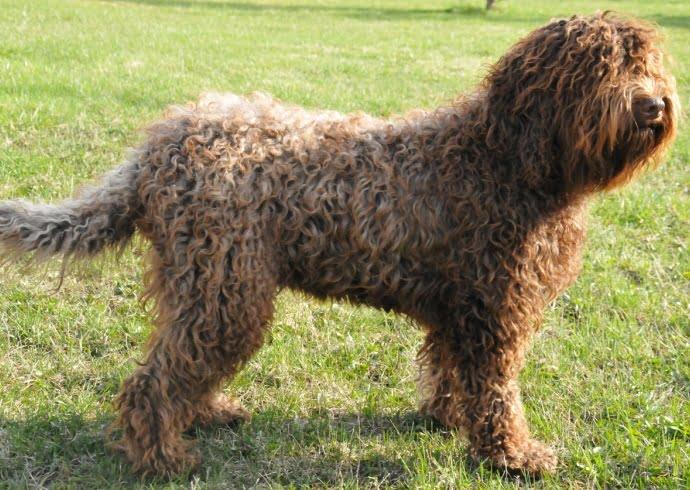
People usually start looking up the Barbet when they’re weighing up a curly-coated “water dog” for family life in Australia: how big it really gets, what that coat demands week to week, and whether it suits a busy household or a quiet one. The wrong match tends to show up later as matted fur, a bored dog, and a routine that never quite settles.
The Barbet is an old French retriever built for wet ground and cold water—steady on land, delighted by a swim, and wrapped in a coat that asks for regular hands-on care. What follows sticks to the practical realities: size, temperament, exercise, grooming, and the health checks worth asking about before you commit.1, 2
Breed category: Gundog (water retriever)
Country of origin: France
Typical height: dogs 58–65 cm; bitches 53–61 cm1
Typical weight: weight should be in proportion to height (many adults sit roughly in the 16–29 kg range)2
Typical lifespan: often 12+ years1
Coat: long, dense, curly; high grooming commitment1, 2
Exercise: active breed; plan on daily exercise and training time2
What a Barbet is (and what it isn’t)
The Barbet is a French water dog developed to locate, flush and retrieve birds in marshy country. That history shows in the build—solid, athletic, slightly longer than tall—and in the instincts: many enjoy carrying things, searching, and getting into water whenever they can.3, 4
It’s sometimes mistaken for a “doodle”, largely because of the coat. But Barbets are a distinct breed with their own standard and working background, not a designer cross.4
History and origin
Barbets have been present in France for centuries as practical hunting companions around water. Artwork and written references place “bearded” water dogs in Europe well before modern kennel clubs existed, and the name itself comes from the French barbe—beard—an accurate description of the furnished muzzle and face.4
In modern registries, the Barbet is recognised as a Sporting/Gundog-type retriever. The American Kennel Club granted full recognition effective 1 January 2020 (Sporting Group).5, 6
Physical characteristics
Size
Barbets are medium-to-large, depending on the line and sex. Breed standards commonly describe an ideal height of:
- Dogs: 58–65 cm
- Bitches: 53–61 cm1
Weight is meant to be in proportion to height rather than a fixed number, which is why you’ll see a wide range quoted in general breed guides.3
Coat, colour, and the “beard”
The coat is the defining feature: profuse, dense, and naturally curly, intended to help protect the dog while working in cold, wet cover. It can be presented at different lengths. A practical “working clip” is acceptable in many standards, but a harsh, short coat texture is not.1, 2
Accepted colours in breed standards include shades of black, grey, brown, and fawn, with or without white (including solid white or white with markings).1
Temperament: what living with a Barbet tends to feel like
Most Barbets are described as friendly, sociable and bright. They’re often comfortable moving through the world with a relaxed confidence—watchful without being sharp—especially when they’ve been well socialised from puppyhood.2, 4
They also tend to be “close” dogs: many prefer being near their people, following the day’s movement from room to room. That can be a pleasure in the right household, and a problem in one where the dog is left alone for long hours without enough exercise and training to take the edge off.4
Training and exercise needs
A Barbet’s brain is always running. Basic obedience usually comes along well with steady, calm repetition, but they do best when training is part of daily life rather than a once-a-week event. Short sessions—done often—fit the breed’s working heritage and attention span.4
For exercise, aim for a daily routine that combines movement and thought. Many Barbets thrive with:
- Brisk walks plus time to sniff and explore (not just marching on lead)
- Retrieving games and simple scent-work in the yard
- Swimming where it’s safe and permitted (coat maintenance matters afterwards)
- Dog sports such as agility or other structured activities2, 4
Grooming and everyday care
The coat is not “set and forget”. It tangles easily, and once mats form they tighten close to the skin—especially behind the ears, in armpits, and around the collar area. Regular brushing and combing is part of normal ownership, not an occasional tidy-up.4
Keep an eye on:
- Ears: floppy, well-furnished ears can trap moisture and debris. Check after swims and after long grass.
- Feet and skin: curls hold burrs and seeds. Quick checks after walks save bigger problems later.
- Trim style: a practical clip can make life easier, but many standards prefer a natural, rustic look rather than stylised grooming.1, 2
Health: common concerns and sensible screening
No dog is “problem free”, and with a rarer breed it’s worth being methodical. In Barbets, commonly discussed inherited issues include hip dysplasia and some eye conditions (including progressive retinal atrophy), and epilepsy is also mentioned in breed discussions.4
Hip dysplasia is a developmental condition of the hip joint that can lead to arthritis and pain. Screening is typically done with veterinary radiographs submitted to an accredited scheme for grading and certification (your breeder should be able to show documented results for the parents).7
If you’re choosing a puppy, ask what health testing is done in that breeding program (and ask to see the paperwork, not just a verbal assurance). At a minimum, many Barbet programs focus on hips and eyes.4
Breeding and ownership considerations in Australia
Barbets suit people who enjoy an active, outdoorsy rhythm and don’t mind regular coat maintenance. They’re usually a better fit for households that can offer:
- daily exercise plus training time
- regular grooming (or a grooming budget)
- safe access to water play, if you want to lean into what the breed loves
- steady social exposure as a puppy, so adult confidence has something solid to grow from2, 4
A quick factual correction: Barbets are not known as “heavy shedders”. Most breed references describe them as low-shedding, but that doesn’t mean low-maintenance—the coat still needs consistent care to prevent matting.2
Famous Barbets: a note of caution
Stories sometimes circulate online about “famous” Barbets linked to wartime mascots or film stars, but these accounts are often muddled or poorly sourced. If you’re looking for reliable breed history, kennel club standards and recognised breed clubs are the safest anchor points.1, 2
Final thoughts
The Barbet is a steady, capable French water retriever with a practical, outdoorsy temperament and a coat that asks for hands-on care. For the right home—one with daily exercise, training, and a grooming routine that doesn’t slip—it can be an absorbing companion: alert, sociable, and quietly devoted, happiest when it has something to do and somewhere to go.2, 4
References
- The Kennel Club (UK) – Barbet: Breed standard
- The Kennel Club (UK) – Barbet: Breed information
- Barbet Club of America – Official standard of the Barbet (size and proportions)
- American Kennel Club – Meet the newest AKC-recognised breed: Barbet
- American Kennel Club – Press release: Barbet and Dogo Argentino gain full recognition (effective 1 January 2020)
- American Kennel Club – Breeds by year recognised (shows Barbet recognised in 2020)
- Orthopedic Foundation for Animals (OFA) – Canine hip dysplasia (overview and screening)
- United Kennel Club – Barbet breed standard

Veterinary Advisor, Veterinarian London Area, United Kingdom