
People usually look up the Bar-shouldered Dove after hearing its steady “cook-a-wook” call in a suburban park, or after spotting a long-tailed dove walking across a lawn and wanting to be sure what they’ve seen. Getting the ID right matters—there are similar-looking doves around towns and gardens, and small details (colour on the hindneck, where it lives, how it moves on the ground) are what separate them.
The Bar-shouldered Dove (Geopelia humeralis) is a common northern and eastern Australian species, also found in southern New Guinea. Below is a clear, field-friendly summary: what it looks like, where it turns up, how it feeds and breeds, and what “Least Concern” really means in practice.1, 2, 3
Quick facts
- Length: about 27–30 cm (a slim, long-tailed dove)3
- Average weight: around 130 g (varies)3
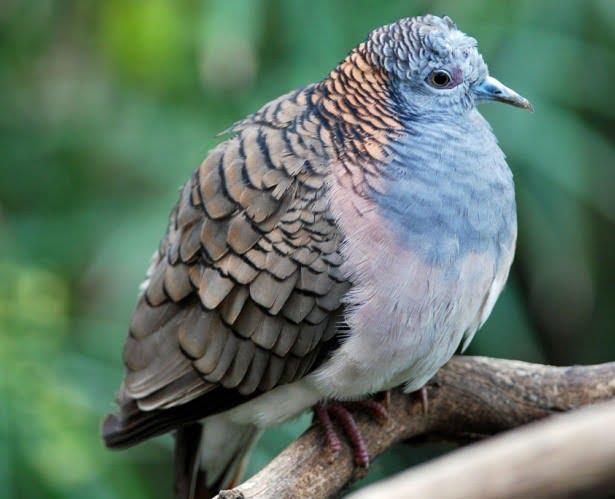
- Distinctive look: blue-grey head and upper breast; a coppery reddish patch on the hindneck with dark barring; pale underparts with a pinkish bar on the lower breast; long, graduated tail with pale tips1, 2
- Typical habitat: woodland with grassy understorey and nearby open ground, often near water; mangroves; urban parks and gardens1, 2, 3
- Diet: mainly seeds (grasses, herbs and sedges), plus plant material such as rhizomes; forages on the ground and drinks through the day3
- Breeding: clutch usually 2 eggs; incubation about 14 days; nestling period around 21 days (timing varies by region)3
- Conservation status: generally listed as Least Concern globally4
Identification: what to look for in the field
The Bar-shouldered Dove is a medium-sized, long-tailed dove with a neat, composed posture when it walks. Up close, the key feature is the coppery reddish patch on the hindneck, edged and barred with darker markings. The head, neck and upper breast are blue-grey, and there is a pinkish bar low on the breast that can catch the light when the bird turns.1, 2
Young birds are plainer. They lack the full hindneck patch and strong barring, and tend to look duller overall until the adult pattern comes through.2
Common mix-ups
In towns and gardens, Bar-shouldered Doves can be confused with other doves at a glance—especially when birds are side-on, partly hidden, or backlit. The safest approach is to check the hindneck pattern and the overall “long-tailed” silhouette, then confirm with voice and habitat.2
Distribution and habitat
Bar-shouldered Doves occur through humid and well-wooded parts of north-western, northern and eastern Australia, from near Onslow in Western Australia across to New South Wales, and also in southern New Guinea. In the north they are a familiar urban bird, particularly around places such as Darwin and Cairns, where their calls become part of the background soundscape.1, 2, 3
They favour woodland with a grassy understorey and nearby open ground, usually close to water. They also use mangroves, and they adapt readily to human-made spaces—suburban streets, sports ovals, school grounds, gardens—so long as there is cover nearby and a steady supply of seed on the ground.1, 2, 3
Diet and feeding behaviour
Most of the day is spent on the ground, working through short grass and bare patches near cover. Their diet is mostly small seeds—grasses, herbs and sedges—along with other plant material such as rhizomes. Unlike some birds that can go long periods without water, Bar-shouldered Doves are regular drinkers and may return to water sources throughout the day.3
They are often seen in pairs or small groups, sometimes loose flocks when food is abundant. Feeding is quiet and methodical: head down, small steps, brief pauses to scan, then back to the ground again.2, 3
Breeding and nesting
Breeding timing varies by region. In northern Australia, breeding can occur year-round, while in southern areas it is more seasonal (commonly peaking around late winter to spring).3
Nests are usually tucked into dense shrubs or small trees, including in gardens. The nest itself is a thin, simple platform of twigs and roots, placed on a branch or in a fork where foliage breaks up the outline. Clutch size is typically two eggs.3
Both parents share incubation (about 14 days) and feed the young. Like other pigeons and doves, they produce “crop milk” for the chicks in the early stages. Young typically remain in the nest for around three weeks before fledging, though local conditions can shift the pace.3
Calls and communication
The call is often what gives them away first: a loud, clear, repeating phrase that BirdLife Australia describes as a distinctive “cook coo cook coo”, alongside a bubbling, descending call. In urban areas, the sound can carry across backyards and along street trees, especially in the cooler parts of the day.3
Conservation status and realistic threats
Globally, the Bar-shouldered Dove is generally treated as a species of Least Concern.4
The original draft overstated a few threats—particularly “illegal trapping for the pet trade”—which is not usually highlighted as a major driver for this common urban-adapted dove in Australia. A more grounded picture is that local pressures are typical of many suburban birds: loss of understorey and safe nesting cover, collisions with vehicles and windows, and predation by introduced animals such as cats. At the same time, the species can benefit from some land clearing and the creation of open feeding areas, which helps explain why it remains widespread and familiar in many northern towns and cities.3
Final thoughts
The Bar-shouldered Dove is one of those birds that becomes more distinctive the more you pay attention. The coppery hindneck patch, the long tail, the steady ground-feeding near cover, and that rhythmic “cook-a-wook” call all fit together into a calm, recognisable presence—equally at home along mangrove edges and in the shade of suburban streets.1, 2, 3
References
- Australian Museum — Bar-shouldered Dove
- Oakvale Wildlife — Bar-shouldered Dove (Geopelia humeralis)
- BirdLife Australia (Birds in Backyards) — Bar-shouldered Dove
- BirdLife International — The IUCN Red List (categories and process)
- Atlas of Living Australia — Geopelia humeralis (Bar-shouldered Dove)
- Australia Zoo — Bar-shouldered Dove
- BirdLife Australia (Birds in Backyards) — Peaceful Dove (for comparison)
- BirdLife Australia — Spotted Dove (introduced species, for comparison)

Veterinary Advisor, Veterinarian London Area, United Kingdom