
People usually search for “Australian black house spider as a pet” after finding one in a window corner or shed and wondering whether it’s safe to keep, safe to remove, or worth leaving alone. The answer depends less on “pet suitability” and more on basic risk, legality, and the spider’s natural habits.
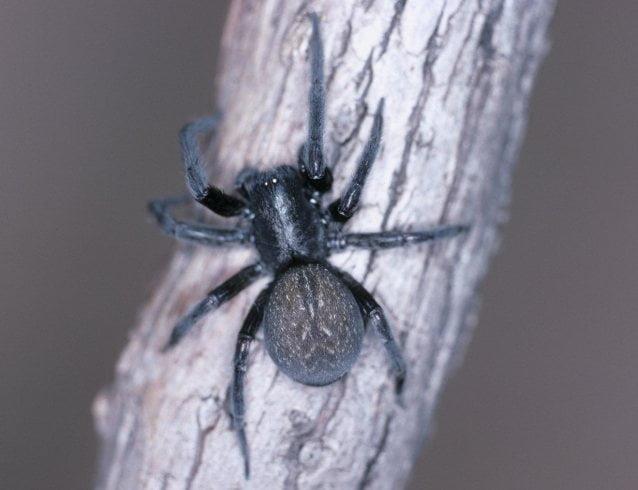
Badumna insignis (the black house spider, sometimes called a window spider) is common around homes, builds a distinctive lacy web with a funnel-like retreat, and is not considered medically dangerous in the way funnel-web spiders are. It can still bite, though, and it’s a wild animal with specific needs that are easy to get wrong in a small enclosure.1, 2, 3
Quick facts: Australian black house spider
- Scientific name: Badumna insignis (family Desidae)2
- Size: females about 12–18 mm body length; males about 9–15 mm2, 3
- Appearance: dark brown to black legs and carapace; charcoal-grey abdomen with pale markings that can be faint; velvety look2, 3
- Where you’ll find it: crevices on rough-barked trees and, very commonly, around buildings—window frames, brick holes, rock walls, sheltered cracks1, 2
- Web: messy sheet with a cone/funnel retreat where the spider waits1, 2
- Typical lifespan: around 2 years (varies with conditions)1, 3
Is it a good idea to keep a black house spider as a pet?
For most people, no. Not because the spider is “evil” or unusually dangerous, but because it’s a sedentary web-builder that does best when it can choose a sheltered crevice and settle in undisturbed. In a tank, it’s easy to end up with a stressed animal, a poorly ventilated setup, or a surprise escape through a gap you didn’t notice.
If you want to observe one, the simplest approach is often to leave it where it is (if it’s not in a high-traffic spot) and treat it as backyard wildlife. If you need it gone, relocation outdoors to a sheltered crack or rough bark is usually safer than handling.
Temperament and handling: what “docile” really looks like
Black house spiders mostly keep to their web and retreat. They can move quickly when disturbed and may bite if pressed, trapped, or handled. They are not animals that benefit from, or reliably tolerate, routine handling.
Practical handling rule: don’t use your hands. Use a container and stiff card, and keep fingers away from the spider and the web funnel. Gloves help, but distance is better.
Venom and bites: what’s known, and what to do
Like almost all spiders, black house spiders are venomous to their prey. A bite to a human is usually a local injury—pain, redness and swelling are common themes in first-aid guidance for non–highly venomous spider bites, with medical review advised if symptoms are severe or the person is a child, unwell, or allergic.4
If a spider bite is suspected:
- Wash the area gently with soap and water.
- Use a cold compress (wrapped) for pain and swelling.4
- Seek urgent help (call 000) if severe symptoms develop, if you suspect a funnel-web bite, or if the person is having trouble breathing or shows signs of a serious allergic reaction.4
Habitat and enclosure: if you keep one, mimic the crevice
In the wild, this spider’s life is built around a fixed retreat: a narrow, dry-ish shelter with a web spread across the entrance. That tells you what an enclosure needs—secure walls, plenty of anchor points, and a quiet corner it can claim.
If you’re keeping a spider legally (see below), general Australian guidance for pet spiders stresses researching the species’ needs and making the enclosure escape-proof while still well ventilated.5
- Ventilation and security matter more than size. A small, well-sealed container with cross-ventilation is often safer than a large tank with gaps.
- Give it structure. Pieces of bark, a cork slab, or a rough “wall” surface encourages web attachment.
- Keep it simple and dry-leaning. Constantly wet substrate can promote mould and mites. Offer a small water source or light misting only if the enclosure is drying out, and ensure good airflow.
Feeding: what it actually eats
Black house spiders are predators of insects and other arthropods. They wait at the funnel retreat and rush out when prey hits the web.1, 2
- Offer appropriately sized live insects (small enough that the spider can subdue them).
- Remove uneaten prey if it’s harassing the spider or wandering for days.
- Skip wild-caught insects from gardens where pesticide exposure is possible.
“Training” and “grooming”: what to ignore
Black house spiders don’t need grooming and they aren’t trainable in any meaningful way. At most, they may habituate to a stable light/dark cycle and to disturbance patterns near the web, but that’s not learned behaviour you can rely on.
Common problems in captivity
Most “health issues” seen in captive spiders come down to husbandry: stale air, damp and mould, dehydration, or stress from repeated disturbance.
- Mites and mould: often linked to damp substrate and poor ventilation.
- Dehydration: can happen in very dry indoor conditions if there’s no water source and no opportunity to drink from droplets.
- Injury: from falls (especially in tall smooth-sided enclosures) or from prey that’s too large.
If you’re worried about a bite to a person, follow recognised first-aid guidance and seek medical advice when symptoms are significant or worsening.4
Legal considerations in Australia (important)
Rules vary by state and territory, and they change. If you plan to keep any native wildlife, check your local regulator first.
- Northern Territory: spiders are protected and you must have a permit to keep a spider as a pet (and you may need additional permissions to take from the wild or to import/export).5
- New South Wales: NSW regulates keeping native animals through a licensing system (with penalties for illegally trapping and keeping wildlife). Whether a spider is covered depends on the relevant species lists and rules at the time.6
- Victoria: Victoria regulates keeping wildlife via schedules in the Wildlife Regulations and associated licence types; whether a species can be kept depends on how it is listed.7
- Queensland: Queensland has a licensing framework for keeping native animals, and also lists exemptions for many invertebrates (with some groups regulated). You must check whether your intended species is exempt or requires a licence under current Queensland rules.8
Do not collect from the wild unless you are clearly permitted to do so. “It was in my house” is not automatically a legal pathway in every jurisdiction.5, 6
Safer alternatives if you want a spider “pet”
If the goal is a calm animal you can observe without frequent worry, look for captive-bred invertebrates sold legally in your state/territory, and choose species that are commonly kept and well understood in captivity. Keep the enclosure secure, ventilated, and out of reach of children and pets.
Are black house spiders aggressive?
They’re defensive when disturbed, but they don’t roam looking for trouble. Most of the time they remain in the web’s funnel retreat and avoid contact.1, 2
Will a black house spider kill me?
They can bite, and any bite can be serious for someone with an allergy or other complications, but black house spiders are not treated as medically dangerous in the way funnel-web spiders are. If you’re unsure what bit you, or symptoms are severe, follow first aid and seek urgent medical help.4
How big do black house spiders get?
Females are typically around 12–18 mm body length; males are smaller, around 9–15 mm.2, 3
Can I just move it outside?
Often, yes. Relocation is best done with a container and card. Place it into a sheltered crevice, rough bark, or a protected corner away from heavy foot traffic.
References
- Australian Geographic — Fact File: Black house spider (Badumna insignis)
- Australian Museum — Black House Spider (Badumna insignis)
- Wikipedia — Black house spider (Badumna insignis)
- Australian Red Cross — First Aid for someone with a spider bite
- Northern Territory Government — Keeping spiders as pets
- Service NSW — Apply for a companion native animal keeper licence
- Victoria (vic.gov.au) — Private wildlife licences
- Queensland Government — Exempt, prohibited and species class listings (keeping native animals)

Veterinary Advisor, Veterinarian London Area, United Kingdom