
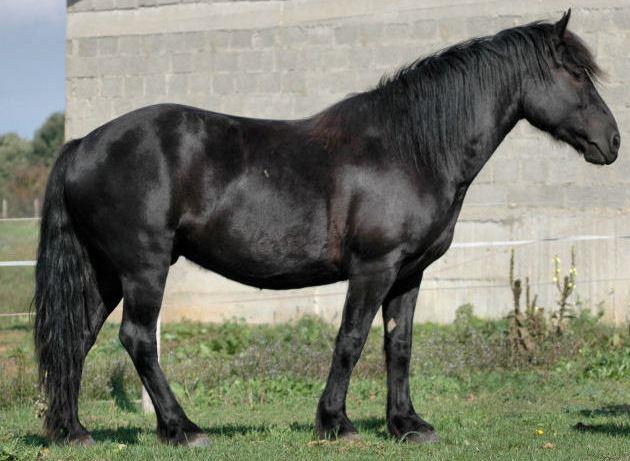
People usually search for an “Ariégeois Pony” because they’ve seen the name in a listing, a breed chart, or an old handbook and want to know what they’re really dealing with before buying, registering, or feeding a horse.
Here’s the quiet truth: “Ariégeois Pony” isn’t a separate modern pony breed with bay-and-chestnut coats. In practice, it’s an older or informal name that most often points to the Mérens (also called Cheval de Mérens), a small, rustic mountain horse from the Ariège and Pyrenees—distinctive for being always black in the stud-book standard.1, 2
Quick facts (what “Ariégeois pony” usually refers to)
- Most likely breed: Mérens (Cheval de Mérens), historically called “Ariégeois pony”1
- Origin: Ariège / Pyrenees (southern France; also found over the border in northern Spain)1
- Typical type: Small, hardy mountain horse used for trekking and driving (and sometimes sport disciplines)1, 2
- Colour in the official breed standard: Black (Mérens), not “usually bay or chestnut”1
Why the name causes confusion
“Ariégeois” simply means “from Ariège”. That makes it a magnet for mix-ups: the same region is associated with more than one equine type, and the word also names a French scent hound (a dog breed), which adds another layer of search-engine chaos.3
Two horse names commonly tangled together are:
- Mérens — the small black mountain horse, still sometimes labelled “Ariégeois pony”.1
- Castillonnais (also known as Cheval Ariégeois de Castillon) — a different local mountain horse from Ariège, generally dark bay/seal brown, and recognised as a distinct breed with a modern conservation story.4, 5
History and origin (Ariège’s mountain horses)
The Ariège and surrounding Pyrenees are steep country: narrow valleys, high summer pastures, and long distances that reward sure feet and a body that stays sound on sparse grazing. The Mérens developed in this setting and became known as a tough explanation-proof horse—useful in harness, under saddle, and for carrying loads where machinery struggled.1, 2
The Castillonnais story is related but separate: it is a local Ariège mountain horse (also called the “Cheval du Biros” or “Saint-Gironnais”) that declined sharply during mechanisation and was later restored through organised conservation breeding, with official recognition in the 1990s.4, 6
Physical characteristics (what to expect in real life)
Mérens (the “Ariégeois pony” in older usage)
Mérens are compact, deep-bodied and built like they belong on rock and grass rather than manicured arenas. Breed descriptions consistently emphasise hardiness, endurance, docility, and above all the black coat required for registration.1
If you’re looking at an animal described as “Ariégeois pony” that is bay or chestnut with a blaze, treat it as a warning sign that the label may be casual marketing rather than a breed identity.
Castillonnais (often confused with “Ariégeois” wording)
Castillonnais are small saddle-horses, commonly listed around 135–155 cm at the withers, and typically dark bay or seal brown rather than black.4, 5
Temperament (what handlers tend to notice)
Mountain horses are shaped as much by management as genetics: long hours outside, big weather, and the need to travel safely on poor footing. In Mérens descriptions, the consistent themes are calmness, docility, and a practical sort of confidence on uneven ground—traits that make sense in a horse expected to go forward without fuss in steep terrain.1, 2
Uses and disciplines
These are not specialist “one-job” animals. The Mérens is widely described as multi-purpose: trekking in mountainous areas is the classic modern use, with carriage driving a close second, and some participation in ridden sport and outdoor endurance-style activities.1, 2
The Castillonnais is also commonly used for trekking and driving, reflecting the same landscape logic, though it is a separate breed identity and should be treated as such for registration and breeding decisions.4, 6
Care, feeding, and everyday management
Rustic doesn’t mean maintenance-free. It means the baseline design tolerates weather and rough ground—but modern domestic life can still trip them up, especially with rich pasture.
- Forage first: Most horses do best on predominantly forage-based diets (pasture and/or hay), with hard feed added only when workload and body condition genuinely require it.7
- Watch weight: Easy-keeping types can gain weight quickly on improved pasture; obesity increases the risk of laminitis and other metabolic problems.8
- Feet and terrain: Sure-footed breeds still need regular farrier attention; the advantage is more about balance and durability than immunity to hoof problems.
- Routine health care: Teeth, vaccination, parasite control, and saddle fit still matter—especially for compact horses that may be ridden by adults as well as children.9
Breeding and genetics (what to be careful about)
The draft you started with describes the “Ariegeois Pony” as a cross between an “Ariegeois” horse and a Welsh pony. That claim doesn’t line up with how recognised French breeds from Ariège are described in mainstream breed references: Mérens is treated as its own established mountain breed, and Castillonnais is documented as a distinct local breed with a formal stud-book and conservation work—neither is generally presented as a modern Welsh cross “breed recipe”.1, 4
If breeding is part of your plan, rely on the relevant stud-book rules and an experienced breeder, not a catchy breed summary. Names are slippery; paperwork is not.
Popularity and conservation outlook
Local mountain breeds can be numerically small compared with global sport-horse populations. The Castillonnais, in particular, is widely described as having narrowly avoided disappearance in the late 20th century, with later official recognition and ongoing preservation efforts.4, 6
Notable “Ariégeois ponies”
Be wary of specific competition claims attached to the name “Ariegeois Pony” (for example, named Olympic horses). Without stud-book confirmation, those stories often trace back to a misunderstanding of breed labels rather than a verifiable record.
If you have a name and a competition year, it’s usually possible to confirm the horse’s breed and registration through official databases or event records—worth doing before repeating the claim.
Is the Ariégeois Pony a real breed?
It’s better treated as an older or informal label. Most credible breed references use it as an alternate name for the Mérens, a small black mountain horse from Ariège.1
Are Ariégeois ponies bay or chestnut with a blaze?
Not if the animal is truly Mérens in the stud-book sense. Mérens are described as always black for registration, so bay/chestnut colouring points to a different breed or an unregistered type.1
Could a seller mean “Castillonnais” instead?
Yes. “Cheval Ariégeois de Castillon” is an alternate name used for the Castillonnais, another Ariège mountain horse with different typical colouring and its own stud-book identity.4, 5
What are they best for?
Trekking and driving are the classic modern uses in breed descriptions for both Mérens and Castillonnais, with some horses also appearing in a range of ridden disciplines depending on individual temperament and training.1, 4
References
- Mérens horse (Cheval de Mérens) – overview, alternate name “Ariégeois pony”, colour and uses
- Ariège.com – The Mérens horse (“black prince of the Pyrenees”)
- Ariégeois – French breed of scent hound (common point of confusion with “Ariégeois”)
- Castillonnais (Cheval Ariégeois de Castillon) – height, colour, uses and notes on rarity
- Castillonnais (cheval) – French-language breed summary and stud-book date
- Ariège.com – Les Écuries du Biros (Castillonnais background and recognition timeline)
- RSPCA – Feeding horses (forage-first principles and diet basics)
- RSPCA Knowledgebase – Laminitis in horses (risk factors and welfare impact)
- Australian Government (DAFF) – Horse health and welfare guidance

Veterinary Advisor, Veterinarian London Area, United Kingdom