
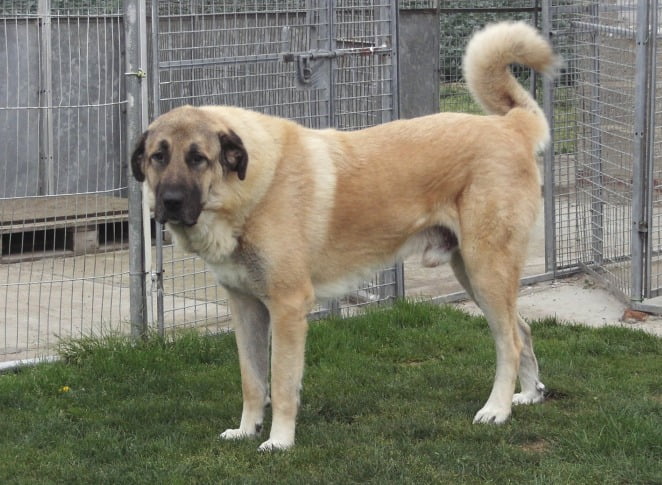
People usually start searching for an “Anatolian Shepherd (Karabash)” when they’re weighing up a serious guardian dog—one that can live with stock, patrol a property, and make calm, independent decisions without needing constant direction. That choice has consequences: these dogs can be steady companions in the right setting, and deeply difficult in the wrong one.
The name itself can also be part of the confusion. “Karabash” is commonly used for Turkish livestock guardian types with a dark mask, and it’s sometimes used interchangeably with “Anatolian Shepherd” depending on country and registry. In Australia, the recognised breed is the Anatolian Shepherd Dog, with a formal standard describing temperament, size, and coat.1, 2
Quick breed snapshot (Dogs Australia standard)
- Group: Utility
- Country of origin: Turkey
- Adult size: Very large, tall, powerfully built
- Height: 74–81 cm (males), 71–79 cm (females)2
- Weight: 50–64 kg (males), 41–59 kg (females)2
- Coat: Short, dense, with thick undercoat
- Colours: All colours except merle (with or without black mask and black ears)2
Origins and history
The Anatolian Shepherd Dog developed in Turkey as a livestock guardian—built to travel with flocks, tolerate heat and cold, and hold ground when a threat tests the boundary. In this work, the dog’s job is not to herd. It is to watch, position itself, warn, and—if pressure keeps coming—defend.2, 3
You’ll sometimes see “Karabash” explained as “black head”, a nod to the dark mask common in many Turkish guardian dogs. In practice, names vary by region and registry, and owners may use “Karabash”, “Kangal”, or “Anatolian” differently depending on where the dog’s lines came from. If paperwork matters (showing, breeding, insurance, council requirements), rely on the registered breed name and standard used in your state and kennel body.1, 2
Temperament: what they’re like to live with
At their best, these dogs are steady, bold without being needlessly sharp, and quietly observant—often appearing relaxed while still tracking movement, sound, and unfamiliar routine. Independence is not a training “problem” so much as a core feature: they were selected to make decisions at distance from people, often at night, often in weather that keeps everyone else indoors.2, 3, 4
That same independence can feel like stubbornness in a suburban home. Many Anatolians are reserved with strangers, territorial around their property line, and quick to use their voice as a warning system. Early, careful socialisation helps, but it doesn’t erase the guardian instinct—it shapes it into something predictable and safe to manage.2, 5
Good match
- Rural or semi-rural homes with space, routine, and strong fencing
- Owners comfortable managing a large, independent dog
- Homes that want a watchful presence more than a “go everywhere” social butterfly
Think twice
- Shared fences with frequent foot traffic, off-lead dogs, or lots of visitors
- Homes wanting an off-lead dog-park regular
- First-time owners without support from a skilled trainer experienced with guardian breeds
Physical characteristics and appearance
The Australian standard describes a large, upstanding dog with a broad, heavy head and a short, dense coat over a thick undercoat—built for stamina and speed rather than bulk alone. Movement is meant to look effortless, with an even gait and an impression of stored power rather than constant bustle.2
Coat colour varies widely. A black mask is common but not required, and the standard allows all colours except merle. That matters if you’re seeing “rare colours” marketed at a premium—rarity claims don’t automatically equal quality, and merle is specifically excluded in the recognised standard.2
Training and exercise: what actually works
Anatolian Shepherd Dogs can learn quickly, but they tend to weigh choices rather than comply automatically. Training goes best when it is calm, consistent, and built around real-life management—boundaries, gates, recall foundations on a long line, and polite behaviour when people arrive—rather than endless repetition.2, 5
Exercise needs are often misunderstood. Many are not hyperactive athletes, but they do need daily movement and purposeful time outdoors. Long walks, property patrols, and training games that use their nose and brain are often more satisfying than frantic ball-throwing. Young dogs, in particular, benefit from controlled exercise and sensible growth management rather than pounding runs and hard jumping on developing joints.5
Health concerns to know about
Like many very large breeds, Anatolian Shepherd Dogs can be affected by orthopaedic conditions such as hip dysplasia and elbow dysplasia, and some lines may be prone to eye issues such as entropion (where the eyelid rolls inward). Ask breeders what screening they do, and have your vet check joints and eyes during routine exams, especially through adolescence when problems may first show up.5
Gastric dilatation-volvulus (bloat): the emergency risk
Large, deep-chested dogs are at higher risk of gastric dilatation-volvulus (GDV), where the stomach distends and can twist. It can become life-threatening within a short window and needs urgent veterinary care.6, 7
- Common warning signs: swollen abdomen, repeated retching without bringing anything up, restlessness, drooling, signs of abdominal pain.6, 7
- Risk-reduction habits: feed multiple smaller meals, discourage rapid eating, avoid hard exercise straight after meals, and discuss preventative gastropexy with your vet if your dog is considered high risk.6, 7
Grooming and day-to-day care
The coat is designed to cope with harsh conditions, but it still benefits from routine maintenance. Brush a couple of times a week to lift dead undercoat and keep skin healthy, then increase frequency during seasonal shedding. Check ears, keep nails at a functional length, and stay on top of dental care—large dogs carry a lot of weight on every joint, and small preventable issues can become big ones when the dog is 50+ kilograms.2
Baths are occasional, not constant. A mild dog shampoo, thorough rinsing, and full drying are usually enough. Many owners find that regular brushing does more for smell and coat condition than frequent washing.
Living with an Anatolian Shepherd Dog: practical considerations
These dogs notice boundaries. A secure, high-quality fence is not optional, and neither is a plan for visitors, tradies, and deliveries. If the dog decides the front gate is part of its patrol route, you need management systems that don’t rely on luck—double gates, signage, and a rehearsed routine for bringing people onto the property.5
They can be gentle with children they know, but supervision is still essential. Their size alone can bowl over a toddler, and their protective responses can switch on quickly if play escalates or a stranger enters the space. For multi-pet homes, early introductions and sensible management matter; many guardians do best when they are raised with the animals they’re expected to live alongside.5
The Anatolian Shepherd Dog in modern times
Across the world, Anatolian Shepherd Dogs remain most valued in the role they were shaped for: guarding livestock and property with steady vigilance. Their strength lies in judgement—watching, assessing, and choosing an appropriate response rather than operating like a dog that waits for permission at every turn.2, 3
Final thoughts
The Anatolian Shepherd Dog (often loosely called “Karabash”) is not a casual pet choice. It’s a large, physically capable guardian with a calm, independent nature and a strong sense of territory. In the right home—space, structure, secure fencing, and an owner who respects what the breed was designed to do—these dogs can be composed, loyal companions and serious protectors. In the wrong setting, the same traits become hard to live with, and hard to undo.2, 3, 5
References
- Dogs Australia (ANKC) – Breed standards index
- Dogs Victoria – Anatolian Shepherd Dog breed standard (Dogs Australia/ANKC)
- American Kennel Club – Anatolian Shepherd Dog as a livestock guardian (traits and role)
- American Kennel Club – Facts on breed history and independence
- Vetstreet – Anatolian Shepherd temperament and management notes
- Cornell University College of Veterinary Medicine – GDV (bloat) overview and risk factors
- VCA Animal Hospitals – Gastric dilatation-volvulus in dogs (risk and urgency)
- PetMD – Anatolian Shepherd: common health concerns (dysplasia, entropion, GDV)

Veterinary Advisor, Veterinarian London Area, United Kingdom