
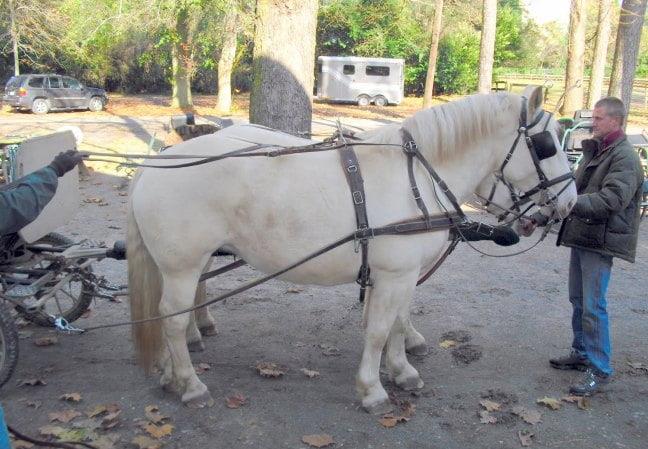
People usually start searching for the American Cream Draft when they’ve seen a pale, cream-coloured draught horse and want to know what it is, how big it gets, and whether it’s the sort of steady animal they can actually manage.
The details matter. This is a rare breed with a very specific coat colour and registry standard, and—like many heavy horses—it can be easy to keep too well. A calm temperament doesn’t cancel out the need for sensible feeding, regular hoof care, and weight checks.
Quick facts (at a glance)
- Height: typically ~15–16 hands for mares, and ~16–16.3 hands for stallions/geldings (about 152–170 cm at the withers)1, 2
- Weight: around 1,500–1,600 lb (mares) and 1,800 lb+ (stallions/geldings) — roughly 680–725 kg and 815 kg+1, 2
- Coat and features: “gold champagne”/cream coat, pink skin with freckling, amber/hazel eyes; white mane and tail are part of the desired look1, 2, 4
- Temperament: generally described as calm, willing, and easy to handle for a draught horse1, 2
- Common uses: driving, farm and light draught work, parades, shows, and pleasure riding (with suitable training and tack)1, 2
- Breed status: rare; listed as “critical” by conservation monitors1
What an American Cream Draft actually is
The American Cream Draft (often written as “American Cream Draft Horse”) is the only draught breed developed in the United States that still exists as a distinct breed today. It’s best recognised by its pale coat and light skin, but it isn’t an albino horse, and it isn’t simply a “white Belgian”.3
The breed standard centres on a medium cream coat (often described as “gold champagne”), pink skin, amber/hazel eyes, and a white mane and tail. Those traits are part of why the horse reads as luminous in sunlight—especially around the muzzle and eyes, where freckling can show through.1, 2, 4
History and origin (Iowa, early 1900s)
The breed developed in Iowa in the early twentieth century, beginning with a cream-coloured foundation mare known as Old Granny. She was noticed at a farm sale in Story County, Iowa, in 1911, and her cream offspring attracted attention because the colour was consistent and distinctive.1, 2, 3
Early breeding involved other draught bloodlines (including Belgian and Percheron-type horses), aiming to fix both type and colour. A breed association and registry were formed in 1944; numbers later fell as mechanisation replaced horse power on farms, and the registry was revived in 1982 as breeders worked to rebuild the population.1, 3
Coat colour and genetics: the champagne difference
The Cream’s signature colour is produced by the champagne dilution acting on a chestnut base coat. That’s why you’ll often see the term “gold champagne” attached to the breed. The look can resemble palomino at a distance, but the underlying genetics and the skin/eye features are different.1, 4
Typical breed features linked to champagne include:
- Pink skin (often with darker freckling/mottling as the horse matures)
- Amber or hazel eyes in adults
- Foals that may be born with very light/blue-toned eyes that darken as they age1, 4
Physical characteristics (size, build, movement)
American Cream Drafts are medium-heavy draught horses: broad through the chest, strong over the back and hindquarters, and built for pulling as well as steady under-saddle work. They’re commonly described as sure-footed, with free, easy movement for their size.1, 2
Corrected size note: some summaries claim 16–18 hands, but most reputable breed descriptions place typical adult height closer to 15–16.3 hands, depending on sex.1, 2
Temperament: what people mean by “gentle”
Handlers and breed profiles consistently describe the American Cream as calm, willing, and cooperative—traits that suit harness work, public events, and owners who prefer an unflustered horse. Still, temperament is shaped by training, handling, and day-to-day management; a large, quiet horse can still be dangerous if it’s bored, under-trained, or pushed when sore.1, 2
Common uses (and what they’re best at)
This breed is most at home in traditional draught and driving roles, but it’s also seen in shows and pleasure riding when conditioned and trained appropriately. Typical jobs include:
- Driving (single, pair, and team)
- Farm and light draught work
- Parades and public events (where steadiness matters)
- Trail and pleasure riding for riders comfortable with a larger horse1, 2
Health and care: the “easy keeper” problem
Heavy horses can gain weight quickly, especially on rich pasture. Extra condition isn’t just cosmetic: it increases the risk of metabolic trouble and laminitis, and it can add strain to joints and feet over time.5, 7
Practical ways to stay ahead of weight gain
- Use a Body Condition Score (BCS) regularly. The Henneke 1–9 system is widely used; many horses do best around a moderate score rather than “rounded”.5, 6
- Track change, not guesses: a weight tape, used the same way each time, is useful for trends (even if it’s not perfect).5
- Manage pasture: lush, high-sugar grass can be a trigger for laminitis in susceptible horses. Limiting access, using a grazing muzzle, or creating a “track” system can help in the right horse and setting.7
- Keep the basics boring and consistent: plenty of appropriate roughage, careful use of hard feed, and routine farrier work.
When to treat it as urgent
If a horse becomes sore-footed, reluctant to move, short-striding, or unusually “pottery” on hard ground—especially after pasture changes—contact your vet promptly. Laminitis can escalate quickly, and early intervention matters.5, 7
Rarity and breed status
American Cream Drafts are uncommon. Conservation listings and breed organisations describe the population as small and vulnerable, which affects availability, breeding decisions, and how carefully bloodlines are managed.1, 3
Final thoughts
The American Cream Draft is a draught horse with a very particular signature: champagne colour, light skin, amber eyes, and a steady way of going. Kept fit and not overfed, it’s the sort of large horse that can move through the world calmly—pulling, carrying, and turning up in public with quiet presence. Its rarity is part of its appeal, and also its responsibility.1, 3
References
- American Cream Draft (overview, history, characteristics)
- Oklahoma State University: American Cream Draft Horses
- American Cream Draft Horse Association (ACDHA): History
- Champagne gene (equine coat colour dilution)
- Cornell University College of Veterinary Medicine: Equine obesity, EMS and laminitis
- Henneke Body Condition Scoring system (1–9 scale)
- Equestrian Western Australia: Nutrition note on pasture, sugars and laminitis risk
- AAEP/IVIS: Endocrinopathic and obesity-associated laminitis (management principles)
- RSPCA Victoria: Monitoring condition, feeding planning, and routine care needs

Veterinary Advisor, Veterinarian London Area, United Kingdom