
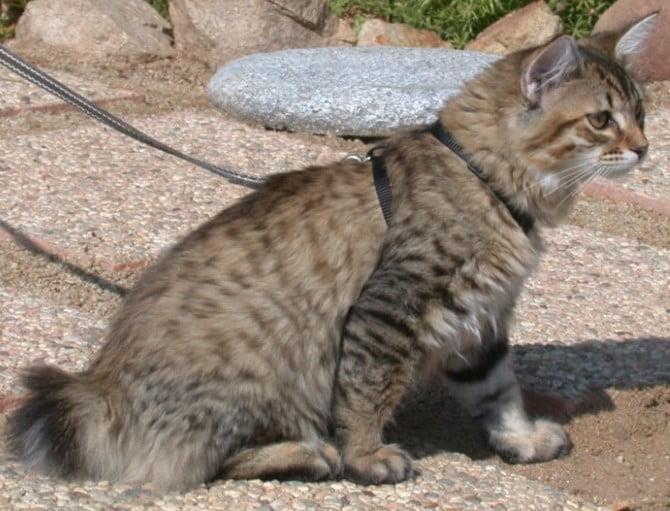
Most people look up the American Bobtail because they’ve seen a cat with that unmistakable short tail and want to know what it’s like to live with one—how big it gets, how much grooming it needs, and whether the tail comes with health risks.
The American Bobtail is a fully domestic breed with a naturally shortened tail, a sturdy build, and a reputation for being bright, interactive, and adaptable. Breed descriptions aren’t a promise of personality, but they do help you understand the shape of the animal you’re choosing—and the sort of care that tends to suit it.1, 2
American Bobtail quick facts
- Size: Medium-to-large, athletic and well-muscled (slow to mature; full size may take 2–3 years).2
- Adult weight (typical): Females about 3.2–5.0 kg; males about 5.4–7.3 kg.2
- Coat: Shorthair or longhair; many cats have a dense, plush feel.1, 2
- Colours/patterns: Comes in a wide range of colours and patterns.1, 2
- Life expectancy: Often quoted around 11–15+ years, with good care (individuals vary).2
- Shedding: Varies by coat length and season; many shed more in spring and autumn.2
History and origin
The American Bobtail’s modern breed development is usually traced to the late 1960s in the United States, with early breeding built around naturally bobtailed cats and later outcrossing to maintain genetic diversity.1, 2
Cat registries describe the breed as “naturally occurring” in the sense that the short tail is a natural mutation seen in domestic cat populations, rather than the result of wildcat hybridisation. The “wild” look is largely a matter of selection for body type, head shape, and expression.1, 2
Physical characteristics
The tail: short, variable, and individual
The hallmark is the shortened tail. No two are identical: length, shape, and flexibility can vary from cat to cat, even within the same litter.2, 3
Body and head
Expect a solid, athletic cat—broad through the chest, well-muscled, and built for climbing and sudden, controlled leaps. Many have a distinctive “hunter’s gaze” described in breed standards, with a broad, modified wedge head and alert expression.1, 2
Coat and grooming workload
American Bobtails come in both shorthair and longhair. Coats are often described as dense, and regular brushing helps lift dead hair and reduce shedding around the house.1, 2
Personality and temperament
Breed organisations commonly describe the American Bobtail as intelligent, affectionate, and highly interactive, often preferring to stay near their people rather than spending long stretches alone. Many do well in busy households and can be sociable with respectful children and other pets when introductions are handled carefully.1, 2
Activity levels are often described as moderate: not a constant-motion cat, but not a decorative one either. Enrichment matters—perches, scratching options, and play that mimics stalking and chasing tend to suit their athletic build.2
Health: what owners should watch for
There isn’t a single “must-expect” disease attached to the breed, and reputable sources generally describe American Bobtails as overall healthy. Still, any purebred population can carry heritable issues, and any individual cat can develop common feline conditions over time.2
Tail genetics and spinal concerns: keep claims proportionate
The American Bobtail’s short tail is a mutation, but it is not the same as the Manx tailless gene. Severe spinal malformations are classically associated with tailless Manx-type genetics (often discussed as “Manx syndrome”), rather than being described as a typical American Bobtail problem.2, 7
Practical takeaway: if a kitten has an unusually rigid tail, an odd gait, weakness in the hind legs, or trouble toileting, that’s a veterinary check—regardless of breed label.7
Urinary tract problems: common in cats, important to recognise early
The original draft mentions “urinary tract issues”. That’s not a breed hallmark so much as a common reason cats visit vets. Learn the warning signs of lower urinary tract disease—straining, frequent trips to the tray, blood in urine, crying when urinating, or urinating outside the tray—and treat it as urgent, especially if little or no urine is produced.6
Routine prevention that actually helps
- Regular health checks: keep vaccinations, parasite control, and dental checks up to date with your vet’s advice.
- Weight management: aim for lean muscle, not bulk; obesity worsens many conditions and reduces mobility over time.8
- Hydration and litter hygiene: fresh water and clean trays support urinary health for any cat.6
Care and grooming
Most American Bobtails cope well with a simple grooming routine. Brushing a couple of times a week suits many coats, with extra sessions during heavier shedding periods. Baths are rarely needed unless the cat gets into something messy.2
- Brushing: 2–3 times weekly (more during seasonal shed).2
- Nails: trim every couple of weeks as needed (indoor cats often need help keeping tips blunt).2
- Teeth: tooth brushing with a vet-approved toothpaste is ideal; ask your vet what’s realistic for your cat and your household.2
Training and socialisation
Training a cat looks less like drilling commands and more like shaping habits. Start early, keep sessions short, and use rewards the cat values (tiny food treats, a favourite toy, or a brief play). Many American Bobtails enjoy interactive games and can learn to come when called, use scratching posts reliably, and tolerate a carrier calmly.2
Socialisation is about gentle exposure: visitors, household noises, handling, and (if relevant) other animals. Move at the cat’s pace and give them escape routes and high resting spots so they can observe from a safe distance.2
Breeding and genetics (a brief, practical view)
The short tail is genetic and variable, which is why tails differ so much between kittens. For prospective owners, the key point is not the novelty of the tail, but the breeder’s health screening, record-keeping, and willingness to discuss temperament and any known issues in their lines.2
American Bobtail in popular culture
The breed occasionally turns up in media round-ups of “unusual” cats, but it’s not reliably tied to specific films, books, or games in a way that helps owners make decisions. What matters day to day is simpler: a sturdy, engaging cat with a short tail, a busy mind, and a strong preference for being part of household life.1, 2
Final thoughts
The American Bobtail is best understood as a capable domestic cat wearing a slightly wild silhouette—medium-to-large, athletic, and often unusually people-focused. If you’re choosing one, look past the tail and towards the foundations: temperament, health history, good early handling, and a home set up for climbing, scratching, and calm routines.1, 2
Do American Bobtails have health problems because of their tail?
Not necessarily. The breed’s short tail is a mutation, but severe spinal problems are more strongly associated with Manx-type tailless genetics than with American Bobtails as a typical breed issue. Still, any kitten with mobility or toileting issues needs a vet check.2, 7
How much grooming do they need?
Usually moderate: brushing a couple of times a week suits many cats, with extra brushing during heavier shedding periods. Longhair individuals may need more frequent combing to prevent tangles.2
Are they good with children and dogs?
Often they are described as adaptable and sociable, but outcomes depend on the individual cat and on careful introductions, respectful handling, and giving the cat safe places to retreat.1, 2
References
- The Cat Fanciers’ Association (CFA) – American Bobtail
- The International Cat Association (TICA) – American Bobtail
- VCA Animal Hospitals – American Bobtail
- The Cat Fanciers’ Association (CFA) – Rare and Unusual Breeds (includes American Bobtail)
- The Cat Fanciers’ Association (CFA) – Recognised Breeds (includes American Bobtail)
- Cornell Feline Health Center – Feline Lower Urinary Tract Disease (FLUTD)
- PetMD – Manx Syndrome in Cats
- World Small Animal Veterinary Association (WSAVA) – Global Nutrition Guidelines

Veterinary Advisor, Veterinarian London Area, United Kingdom