
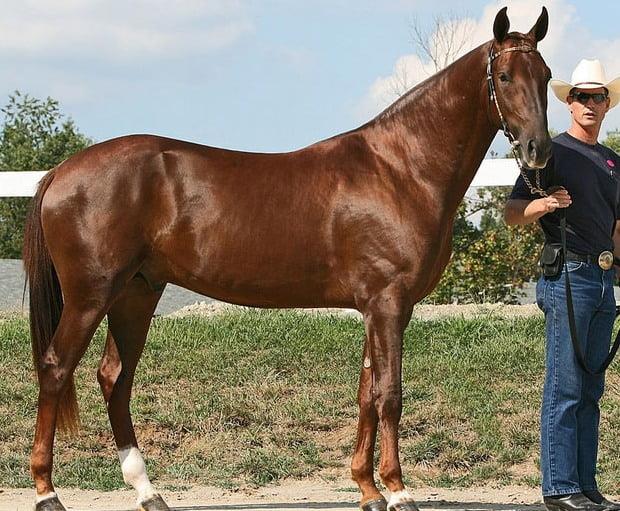
People usually look up the Akhal-Teke when they’re trying to identify a “golden, metallic” horse they’ve seen online, or they’re weighing up whether the breed’s look and reputation match the reality of living with one. The details matter: this is a rare breed with a distinctive type, and it can be easy to confuse myth, marketing, and older stories with what’s reliably known.
Below is a clear, grounded guide to where the Akhal‑Teke comes from, what its famous sheen is (and isn’t), what it’s like in work, and what sensible care looks like—especially if you’re in Australia, where numbers are very small.1, 2
Origin and history
The Akhal‑Teke is a riding horse breed associated with Turkmenistan, named for the Akhal oasis region and the Teke people who bred horses there under demanding desert conditions.1
You’ll often see it described as “one of the oldest” surviving horse breeds. That’s plausible, but it’s not the sort of claim anyone can prove cleanly: before about the early modern period, horses weren’t recorded as fixed “breeds” in today’s sense, and written evidence is patchy. What can be said with more confidence is that the Akhal‑Teke sits within a long Central Asian tradition of fast, enduring riding horses, and it has been formally managed through studbook systems in the modern era.1, 3
What they look like (and why they look that way)
An Akhal‑Teke is typically lean, long-lined, and dry through the leg—built like a distance traveller rather than a heavy all‑rounder. Common features include a refined head, long ears, a long neck set high, prominent withers, and a sparse mane and tail on many individuals.1
The metallic sheen: a real effect, with a complicated cause
The “metallic” shine is real in many Akhal‑Tekes, especially in lighter or cream-diluted colours, but it isn’t a separate coat colour on its own. It’s an optical effect linked to hair and coat structure interacting with light. Modern work comparing Akhal‑Teke hair to other breeds supports the idea that measurable structural and biochemical differences in the hair are involved, though the exact mechanism is still being studied.4
Some sources also describe the sheen as related to unusually fine hair and light reflection through the hair shaft. You’ll sometimes hear claims about “hollow hair”; treat that as an explanatory shorthand rather than a settled fact across all lines and individuals.5
Colours and markings
Akhal‑Tekes appear in a wide range of solid colours and dilutions. Bays, duns, blacks, chestnuts and greys are all seen, and cream dilutions (such as palomino-like shades) can make the sheen look especially vivid.1
Temperament and movement
Temperament varies by breeding and handling, as with any horse, but Akhal‑Tekes are often described as alert and sensitive. They tend to do best with calm, consistent training rather than force. Their movement is commonly long-striding and efficient—more like a stayer than a sprint specialist.1
Strengths: where Akhal‑Tekes tend to shine
The breed has a strong reputation for stamina and toughness, shaped by generations in arid environments with large distances and scarce resources. That heritage is one reason Akhal‑Tekes turn up in endurance, as well as in sporthorse disciplines when matched thoughtfully to rider skill and training style.1
- Endurance and distance work: often a natural fit for the type.1
- Dressage and show disciplines: seen in various countries, though individuals vary widely in aptitude.1
- General athleticism: light, efficient bodies can suit jumping and eventing for some horses, but the breed is not uniformly built for big power fences.1
A common exaggeration worth correcting: there’s no breed-wide basis for claims that Akhal‑Tekes “easily clear six feet”. Some individuals may jump well, but fence height is shaped by conformation, training, soundness, and rider—far more than breed name.1
Care and management: practical notes
Day-to-day care is broadly standard horse husbandry—good forage, clean water, appropriate hard feed if needed, routine hoof care, dental care, parasite control, and sensible conditioning. What tends to matter most with Akhal‑Tekes is not exotic feeding, but thoughtful management of a lighter-framed, sometimes fine-coated horse:
- Conditioning over time: stamina builds slowly and safely; avoid rushing fitness, especially in young horses.
- Skin and coat: many have thin skin and fine hair; rugs, sun management, and gentle grooming can be useful depending on climate and colour.1
- Handling and training: use clear signals and steady repetition; sensitivity can look like “hotness” when the horse is confused or overfaced.
Breeding and registration (why paperwork matters with rare horses)
If you’re considering breeding, treat registration and parentage verification as essential, not optional. Akhal‑Tekes are managed through established studbook and registry systems, and because the global population is small, responsible breeders pay close attention to pedigree, genetic diversity, and avoidable inherited problems.1, 3
Rarity, conservation, and global distribution
Akhal‑Tekes are rare worldwide, with estimates commonly in the thousands rather than the hundreds of thousands seen in mass breeds. Published figures vary by source and by what’s counted (registered purebreds, living horses, active breeding animals), but the consistent message is that this is a small global population with conservation interest.1, 6
Conservation organisations also list the breed as at risk, and Australian rare-breed reporting notes an extremely small local population.7, 8
Australia: a very small footprint
In Australia, Akhal‑Tekes are present but scarce. Local rare-breed tracking suggests only a handful of purebreds, with the population shifting as imports, semen, and occasional foals change the picture from year to year. Expect limited availability and long lead times if you’re looking for a specific pedigree or performance prospect.7
Common myths and quick clarifications
- “The sheen comes from a ‘tobacco-coloured protein’.” The sheen is better described as an optical effect related to hair structure and composition; the “tobacco-coloured protein” claim isn’t a standard scientific explanation.4
- “They’re all golden.” Many colours exist; the golden look is most striking in some coats and in certain light.1
- “They’re endangered everywhere.” Risk labels vary between organisations and frameworks. What’s consistent is rarity and the need for careful breeding stewardship.7, 8
Final thoughts
The Akhal‑Teke is a spare, desert-shaped riding horse with a coat that can catch the light like polished metal. It isn’t a magical superhorse, and it isn’t just a pretty face. In the right hands—patient, observant, and willing to build fitness and trust—an Akhal‑Teke can be a durable, athletic partner. In Australia, the simplest reality is scarcity: if you want one, plan carefully, check registration, and take your time choosing a horse whose temperament and training match your day-to-day life.1, 7
References
- Akhal-Teke (overview: history, characteristics, colours)
- Akhal-Teke Association of America (breed preservation and registration information)
- Akhal-Teke Foundation: Akhal-Teke breed overview and historical notes
- Hagenbeck, C.F. (2024). The secret of the unique metallic shine of Akhal-Teke coat: chemical comparison of Akhal-Teke hair with other horse breeds (thesis record and PDF)
- Globe Trotting (Equestrian Australia): Horse Breed: Akhal-Teke (coat sheen description and general breed summary)
- Euronews (2017): Turkmenistan’s Akhal-Teke (rarity and cultural context)
- Rare Breeds Trust of Australia: Akhal Teke (Australian status and notes)
- Equus Survival Trust (equine conservation and at-risk breed listings)

Veterinary Advisor, Veterinarian London Area, United Kingdom