
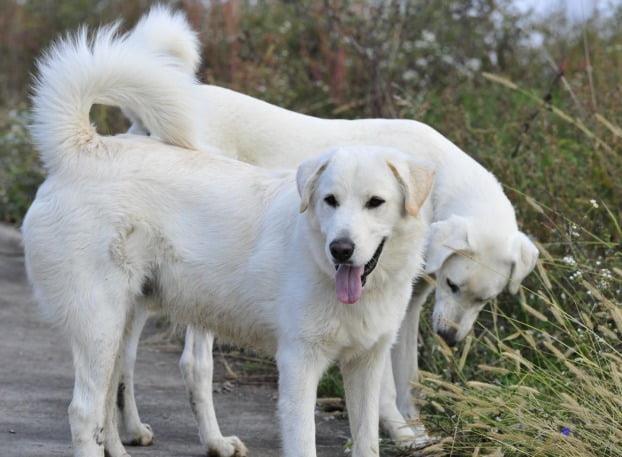
People usually start looking into the Akbash when they need a calm, capable guardian for stock, acreage, or a quiet household—something large enough to deter predators, but steady enough to live around family routines. The wrong match can mean constant barking, roaming, neighbour trouble, or a dog that feels trapped and turns anxious.
The Akbash is an old Turkish livestock guardian: lean for its size, mostly white, and built to watch for long hours before it moves. Below you’ll find a straight answer on what the breed is (and isn’t), what daily life tends to look like, how big they get, and what health risks owners should take seriously.
Akbash at a glance
- Type: Livestock guardian dog (LGD), traditionally used to protect flocks in western Anatolia, Turkey.1
- Size: Large, lean, athletic. UKC desirable height: males 76–86 cm (30–34 in), females 71–81 cm (28–32 in).2
- Coat and colour: Double coat; white, with light biscuit/grey shading acceptable (overall appearance should remain white).2
- Life expectancy: Often around 10–12 years, but varies with genetics, body condition, and workload.3
- Temperament (typical): Watchful, independent, reserved with strangers; strongly protective when bonded and correctly managed.2
Origins and history
The Akbash is a traditional flock-guardian dog associated with western Anatolia. It was shaped for open country and long days: a dog that can stay with stock, scan the horizon, and respond fast when a threat commits.1
Outside Turkey, the breed became better known after fieldwork and imports to North America in the 1970s, followed by use in predator-control and livestock-guarding programs. The United Kennel Club (UKC) recognised the Akbash in 1998.4
One important housekeeping note: despite occasional claims online, the Akbash is not recognised by the Australian National Kennel Council (Dogs Australia) as a breed standard listing. If ANKC recognition matters to you for showing or breeding, check the current Dogs Australia breed standards index directly.5
Physical characteristics and appearance
Akbash dogs are large but not blocky. In good condition they read as tall, long-legged, and spare—made for distance and heat as much as cold nights. The head is wedge-shaped, the ears drop (not upright), and the tail often carries in a curve when the dog is moving.2
The coat is always white overall. Light shading—often biscuit or grey—can appear around the ears or in the undercoat without being considered out of type in UKC descriptions.2
Size guide (UKC standard)
- Males: 76–86 cm (30–34 in) at the withers; average weight around 54 kg (120 lb).2
- Females: 71–81 cm (28–32 in) at the withers; average weight around 41 kg (90 lb).2
Those numbers are a guide, not a promise. Working-line dogs can sit outside “average” while still being healthy and capable.
Temperament: what living with an Akbash is like
The classic Akbash pattern is quiet observation. Many will choose a vantage point and hold it, shifting position to keep wind and sightlines in their favour. This is not the same temperament as a people-focused companion breed; it’s closer to a slow-burning readiness, especially at night.2
Common traits owners notice:
- Independence: they make decisions and may not repeat obedience “just because”.3
- Territorial awareness: boundaries matter; so does consistent handling of gates, fences, and visitors.3
- Reserve with strangers: socialisation isn’t about making them “friendly with everyone”; it’s about making them steady and predictable around normal life.3
Training and socialisation
With an Akbash, training is less about tricks and more about habits: what the dog rehearses daily is what you’ll get at maturity. Start early, keep sessions short, and avoid turning everything into a contest.
Practical priorities that tend to pay off:
- Calm lead walking before the dog reaches full strength.
- Stationing and settling (mat/place training) so the dog has a job when people arrive.
- Visitor routines: where the dog goes, who holds the lead, what “release” looks like.
- Stock introductions done slowly (if you’re using the dog as an LGD), with supervision and safe pens while the dog learns the rules of your property.
If you’re in an urban or suburban setting, plan for extra management. Guardian breeds can default to patrolling and barking when they feel responsible for the whole street.
Exercise and daily needs
Akbash dogs aren’t usually hyperactive, but they do need purposeful movement and mental engagement. On properties, much of their activity is self-directed patrol and observation. In pet homes, you’ll need to replace that with structured walks and calm, consistent enrichment—without encouraging suspiciousness.
They cope poorly with long-term boredom. A large guardian with nothing to do will invent work, and it’s rarely the sort you want.
Health issues to take seriously
Large, deep-chested dogs have increased risk of gastric dilatation-volvulus (GDV), often called “bloat”. It can become life-threatening quickly and needs urgent veterinary care. Know the signs (unproductive retching, swelling abdomen, distress) and have an emergency plan.6, 7
Hip dysplasia is also a known concern across many large breeds. If you’re buying a puppy, ask what hip scoring or screening has been done in the breeding dogs, and what the results were.
For GDV risk reduction, discuss practical steps with your vet. General guidance often includes avoiding one very large daily meal, slowing fast eating, and skipping hard exercise right after meals (your vet may also discuss preventive gastropexy in high-risk dogs).6, 7
Grooming and coat care
The white coat is functional, not ornamental. It sheds, and it will pick up burrs and dust. Weekly brushing is a realistic baseline for most homes, with more during seasonal shedding. Occasional bathing is usually enough, provided the coat is dried well and the skin is kept healthy.
Working role: livestock guardian (not a cattle “cutting” dog)
Akbash dogs are livestock guardians. Their traditional job is to stay with animals and deter predators, not to herd or move stock to a handler’s command.1, 2
The earlier draft mentioned the rodeo sport of cutting and suggested Akbash dogs are used to separate cattle from a herd. Cutting is a horse-and-rider event; dogs are not the standard working partner in that sport. If you’re choosing an Akbash, assume their strengths are night watch, perimeter control, and flock bonding—not precision herding.
Akbash in popular culture and media
Claims that an Akbash played Buck in The Call of the Wild, or featured as a main companion animal in Game of Thrones, don’t hold up against reliable sources. The breed is relatively rare, and it’s more often seen in working-dog contexts than as a named “celebrity” breed.3
Final thoughts
The Akbash is at its best when it has space, clear boundaries, and a role that makes sense to a guardian mind. In the right setting, they can be steady, quiet company—white-coated, long-legged, and patient as weather. In the wrong setting, that same watchfulness can spill into constant alerts and hard-to-manage suspicion.
If you’re considering one, spend time with adult dogs (not just puppies), talk frankly with breeders or working owners about barking, fencing, and visitor management, and involve your vet early—especially around large-breed growth, joints, and GDV risk.
References
- Akbash (overview, origin, and use as a flock guardian) – Wikipedia
- Akbash breed standard – United Kennel Club (UKC)
- Akbash: breed characteristics & care – The Spruce Pets
- Breed standards and breed history notes – Akbash Dogs International
- Breed Standards index – Dogs Australia (ANKC)
- Gastric dilatation volvulus (GDV) or “bloat” – Cornell University College of Veterinary Medicine
- Understanding canine bloat (GDV): a medical emergency – American Animal Hospital Association (AAHA)

Veterinary Advisor, Veterinarian London Area, United Kingdom