
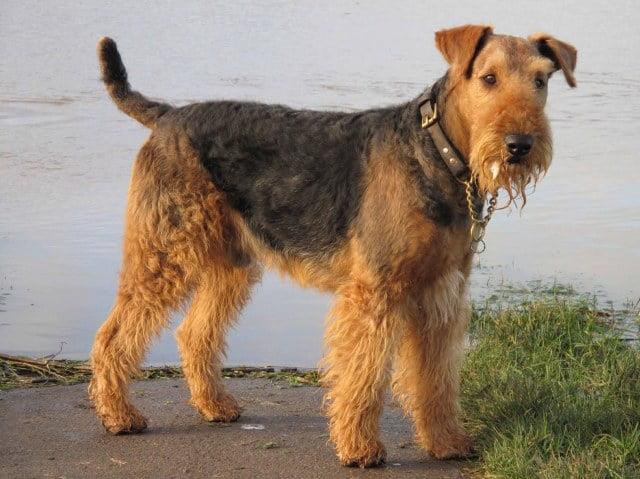
People usually start searching for Airedale Terrier information when they’re weighing up a pup, trying to understand a newly adopted dog, or checking whether a “large terrier” will fit their household. The details matter: size, energy, grooming, and common health risks all shape what day-to-day life looks like.
The Airedale Terrier is the largest of the terriers, built for active work and busy brains. Expect a wiry coat that needs regular maintenance, an alert nature, and a dog that does best with consistent training and plenty to do.
At a glance
- Size: Large terrier; males commonly around 58–61 cm at the shoulder, females about 56–59 cm1, 2
- Typical weight: Often around 20–28 kg, depending on sex and build (individual dogs vary)1, 3
- Coat: Hard, dense, wiry outer coat with a softer undercoat; usually black/grizzle saddle with tan1
- Temperament: Alert, confident, independent; can be steady with family and watchful with strangers (varies with breeding, socialisation, and training)1
- Energy level: High—needs daily exercise and mental work
- Grooming needs: Regular brushing; many owners use hand-stripping or professional grooming to keep coat texture tidy1
- Life expectancy: Commonly around 10–13 years3
History and origin
The Airedale Terrier was developed in the Aire Valley of Yorkshire, England, as a practical all-rounder: a dog that could hunt, guard, and work alongside people in a tough landscape. It sits in the terrier group, but carries more height and substance than most of its cousins—one reason it’s often called the “king of terriers”.1
Physical characteristics and appearance
An Airedale is a square, athletic dog with a long head, dark eyes, and V-shaped ears folding forward. The breed’s signature is its harsh, wiry jacket over a softer undercoat—designed to shed water and resist brambles rather than lie silky flat.1
Colour is typically a black or grizzled “saddle” over the back with tan on the legs, head, and underbody. Breed standards describe the ideal height range; real dogs can sit a little above or below it.1
Temperament: what living with an Airedale is like
Airedales tend to move through the world with a calm, switched-on confidence. They notice changes. They investigate. They can be affectionate with their people, but they’re rarely clingy in the way some companion breeds are.
Many are naturally watchful and will bark to announce visitors or unfamiliar movement. This isn’t “bad behaviour” so much as a default setting that needs shaping—early, gently, and consistently.
Children and other pets
With respectful handling and supervision, Airedales can live well with children. Their size and springy energy mean accidental knocks are possible, especially with toddlers, so calm boundaries matter.
Some Airedales have a strong chase instinct. Introductions to cats and small pets should be slow and managed, and outdoor spaces need secure fencing. Early socialisation helps, but it doesn’t erase instinct.
Training and exercise needs
This breed is bright and independent. Training works best when it feels like a conversation rather than a contest—short sessions, clear cues, and rewards that matter to the dog (food, play, permission to sniff and explore). Reward-based methods are widely supported as effective and lower-risk for welfare compared with aversive approaches.4
Exercise needs vary by age and individual, but most adult Airedales do best with a daily mix of:
- brisk walking or running
- free sniffing time (on-lead is fine)
- training games (recall, loose-lead walking, tricks)
- problem-solving (food puzzles, scent work, hide-and-seek)
Without enough work, some Airedales will invent their own—digging, dismantling the garden, or patrolling the fence line with enthusiasm.
Grooming and coat maintenance
The Airedale’s coat doesn’t look after itself. Brush regularly to remove debris and prevent mats, especially around the legs, beard, and underarms. Many owners book periodic professional grooming or learn hand-stripping to maintain the coat’s hard texture and neat outline.1
Bathing should be occasional rather than constant. Use a shampoo made for dogs, because canine skin pH differs from human skin and frequent or inappropriate products can contribute to dryness and irritation.5
Also keep up with the quiet basics: nails, ears, and teeth. Small maintenance done often is usually easier than big fixes done late.
Health concerns to be aware of
No breed is guaranteed “problem free”. The most sensible approach is to know what can happen, choose a reputable breeder or rescue pathway, and keep regular veterinary care.
Hip dysplasia (and later arthritis)
Hip dysplasia is a developmental disorder where the hip joint doesn’t form as snugly as it should. Over time, that looseness can lead to pain and osteoarthritis. It’s seen most often in larger dogs, and signs can include stiffness, reluctance to jump, or a “bunny-hopping” gait when running.6
Eye conditions (including cataracts)
Cataracts are a clouding of the lens that can affect vision. In dogs, cataracts may be inherited, age-related, or linked to other disease processes (such as diabetes). A veterinary exam is the only reliable way to sort out the cause and significance for an individual dog.7
Skin allergies and irritation
Itchy skin has many possible triggers—fleas, food reactions, environmental allergies, infection, or grooming products. If scratching, redness, ear irritation, or recurrent “hot spots” become a pattern, it’s worth a structured plan with your vet rather than cycling through random shampoos and supplements.
Working roles: hunting and service work
Airedales were bred to be versatile. Historically they’ve been used for hunting and for various service roles, where their confidence, physical toughness, and trainability were valued. Today, many still thrive when given a “job”, even if that job is scent games in the backyard and structured training at the local club.
Final thoughts
The Airedale Terrier suits people who enjoy an active dog with opinions. Give them steady training, daily exercise, and coat care that doesn’t slide, and you’ll often see the breed at its best: alert, capable, and quietly devoted. Skimp on stimulation and routine, and you’ll meet the other side of the terrier story—restless energy looking for somewhere to land.
References
- The Kennel Club (UK) – Airedale Terrier breed standard
- Dogs NSW – Airedale Terrier breed standard
- Hill’s Pet Nutrition – Airedale Terrier breed profile
- American Veterinary Society of Animal Behavior (AVSAB) – Reward-based training statement
- RSPCA Pet Insurance Australia – Guide to dog cleaning and grooming (shampoo and bathing frequency)
- Merck Veterinary Manual (Pet Owner Version) – Hip dysplasia in dogs
- American Kennel Club – Cataracts in dogs (causes and overview)

Veterinary Advisor, Veterinarian London Area, United Kingdom