
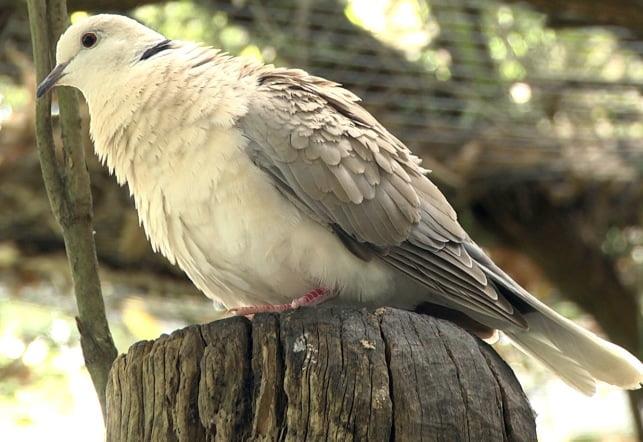
People usually search “African collared dove” when they’re trying to identify a pale, collared dove in the backyard, work out whether it’s native or introduced, or check what’s involved in keeping a “Barbary dove” as a pet. A close look matters: several similar doves turn up around houses and parks, and the rules and ethics around keeping, trading, or releasing birds can carry real consequences for wildlife and for you.
Below is a clear field-guide style profile of the African Collared Dove (Streptopelia roseogrisea): what it looks and sounds like, where it naturally occurs, what it eats, how it breeds, and why “African collared dove” and “Barbary dove” are often tangled together.1, 2
Quick facts
- Scientific name: Streptopelia roseogrisea1, 2
- Size: about 26–27 cm long; wingspan roughly 45–50 cm2
- Weight: about 130–166 g2
- Key mark: a narrow black half-collar on the back of the neck (often edged pale)2
- Typical clutch: 2 eggs3
- Conservation status: Least Concern (global)1
Identification: what you’re likely to notice first
The African Collared Dove is a medium-sized, pale dove. In good light it can look creamy-buff to greyish, with a small head, a fine bill, and a fairly square-ended tail. The collar is not a full ring; it’s a dark crescent set on the hindneck, sometimes with a narrow pale edge that makes it stand out.2
Juveniles can be confusing: they may show little to no collar, and the whole bird looks softer and duller. If you’re relying on the neck mark alone, give the bird time to turn and settle—many quick sightings miss it.2
Common mix-ups
In Australia, most “collared” doves people see in suburbs are more often Spotted Doves or other introduced doves, not African Collared Doves. The African Collared Dove is generally paler and plainer than a Spotted Dove, which carries a distinctive speckled patch on the side of the neck rather than a simple black crescent.2, 4
Habitat and natural range
In its native range, the African Collared Dove is associated with arid and semi-arid landscapes—scrub, savanna edges, and open country—often close to water. It also turns up around farms, towns, and planted areas where food and drinking water are dependable.5, 2
Its natural distribution centres on the Sahel and parts of the Horn of Africa, extending into south-western Arabia.2
Is it “common in Australia”?
Not in the way Spotted Doves are common. Some Australian bird directories describe the African Collared Dove as an introduced species with rare, localised occurrences rather than a widespread, firmly established bird across the country.6
Diet and feeding behaviour
This is largely a seed and grain eater. It spends a lot of time on the ground, walking with a steady head-bob, picking at fallen seed, spilled stock feed, and small plant fragments. When conditions allow, it will also take berries and small invertebrates such as insects and snails—useful protein when breeding or raising young.2, 1
Breeding and life cycle
African Collared Doves typically build a light, twig platform—often in a tree or shrub, sometimes in a sheltered nook around buildings. The usual clutch is two white eggs, and both adults share incubation and chick care, swapping duties in a quiet, practiced rhythm.3, 5
Incubation is about two weeks, and chicks can fledge at around two weeks as well, though they may remain dependent for longer while they learn to feed efficiently and stay out of trouble.5
Social behaviour and calls
Like many doves, they are often seen in pairs or loose groups, especially where feeding is predictable. Their flight is direct, with quick wingbeats and short glides, and they often perch on wires or bare branches to call and watch the ground below.6
“African collared dove” vs “Barbary dove”: why the names get tangled
The “Barbary dove” is widely treated as a domestic form descended from the African Collared Dove. In practice, that means many pet “ringneck doves” (often sold under Barbary/ringneck names) trace back to domesticated stock rather than wild birds, and selective breeding has produced a wide range of colours well beyond the wild type.7, 8
Taxonomy around the domestic form has a long, complicated history, and you may still see different scientific names used in older books or hobby circles. If you’re dealing with permits, biosecurity, or wildlife rules, the safest approach is to use the current scientific name used by the authority you’re dealing with and confirm the identity of the bird (wild type vs domestic) before you act.7
Conservation status and threats
Globally, the African Collared Dove is listed as Least Concern. That doesn’t mean it faces no pressures—habitat change, hunting, and trapping can affect local populations—but there is no indication of a global decline severe enough to place it in a threatened category at present.1
If you’re thinking of keeping one as a pet
Most people looking for a companion bird are actually considering a domesticated “Barbary dove/ringneck dove” rather than a wild African Collared Dove. Even so, the same basic welfare needs apply: stable housing that protects from weather and predators, room to fly and exercise, a seed-based diet balanced with appropriate supplements, clean water, and a calm routine.
Just as important: never release unwanted birds. Released domestic doves rarely fare well, and escapes or releases can create long-running problems for local wildlife and for councils managing introduced species.3
References
- IUCN Red List – BirdLife International: Streptopelia roseogrisea (African Collared Dove)
- Cornell Lab of Ornithology (All About Birds) – African Collared-Dove: Identification (measurements and key features)
- Cornell Lab of Ornithology (All About Birds) – African Collared-Dove: Life history (nesting and clutch size)
- BirdLife Australia – Spotted Dove (profile and identification)
- Animal Diversity Web (University of Michigan Museum of Zoology) – Streptopelia roseogrisea account
- Wingmate Birds Australia – African Collared-Dove (Australian occurrence summary)
- AviList / IOC World Bird List (taxonomic listing context for doves)
- Bulletin of the British Ornithologists’ Club (2023) – “The Founding Feathers: the true ancestry of the domestic Barbary Dove”

Veterinary Advisor, Veterinarian London Area, United Kingdom